
My Books

“I actually could not put the book down. It is well written and kept my interest. I want more from this author.”
Reader review of Maximilian and Carlotta Are Dead on Amazon.com 

Afranor Books

All books available in paperback from Afranor Books on Bookshop.org.
See below on the right-hand side of this page for links to other sellers.
Afranor Books

Thursday, April 24, 2025

Holding Cúirt

For lovers of literature, springtime in the West of Ireland means, among other things, that it is time for Cúirt. An international festival of literature, it does for book lovers what summer’s Galway Film Fleadh does for film buffs.

Cúirt has come and gone for another April, and thanks to serious prompting from our kid, the Missus and I found ourselves present there on the final day. Given all the things that have been taking up our time over the past few weeks, we quite likely would have missed the whole festival altogether if we hadn’t committed ourselves by buying tickets months ago. So, we took time out from an ongoing series of family gatherings—organized around mourning a recently departed and much beloved family member—to head to Galway on a Sunday.

The word cúirt is Irish for court, and it refers to the old Gaelic tradition of the court of poets. Thus, the name was chosen for a modern literary festival founded forty years ago this year. It began as a three-day international poetry festival and since evolved into a week-long program of events celebrating all kinds of literary arts. These include readings, discussions, book launches and workshops.

The particular event we attended included readings, discussion and singing performances by Scottish musician and author Stuart Murdoch. He will be best known by the band name under which he and his various collaborators perform: Belle and Sebastian. (The name was borrowed from a 1960s French children’s novel and TV series.) My kid has long been a fan of the group, to the point she even dragged her mother along to a concert in Paisley, Scotland, a year and a half ago. Currently studying in Chicago, she couldn’t make Murdoch’s appearance at Cúirt, but she convinced her parents to go in her stead.

That is how we came to be present in the intimate Mick Lally Theatre, part of Galway’s historic Druid Theatre, to hear Murdoch read passages from his debut novel Nobody’s Empire, which is also the title of one of his songs. His previous books include the 2010 memoir The Celestial Café, a 2022 collection of song lyrics (with illustrations by Pamela Tait), and the screenplay for the 2014 movie God Help the Girl, which Murdoch directed.

Nobody’s Empire is a semi-autobiographical (autofiction, as described by his publisher) coming-of-age account of his fictional alter-ego Stephen’s youthful struggle with myalgic encephalomyelitis (ME), also known as chronic fatigue syndrome, his forming of an ad hoc support group with a pair of friends, and his discovery of his talent for music. A life-changing journey to America and a spiritual awakening follow.

Not surprisingly, Murdoch turned out to be one of the most genuinely nice and engaging people one could hope to meet, generous with his time and himself. A special treat was getting a mini-concert with him on guitar. He noted that, while he had played concerts in Ireland before, this was his first time ever singing in Galway. One hopes he will be back.

Afterwards, as people queued up with copies of his book—and a fair few Belle and Sebastian LPs—he graciously signed all of them and chatted with all comers as long as they wished. He wrote a message to our kid in our copy of the book, while patiently listening to the Missus’s full recounting of the comedy-of-errors journey from Dublin that mother and daughter made to Glasgow and the snafu of (paper) concert tickets that remained in an inbox somewhere in Trinity College while venue staff sorted things out so the ladies could be allowed entry to the concert hall. He even graciously recorded a voice message to our girl on Mom’s phone, thanking her for having come to the concert.

It was the kind of experience that reaffirms one’s faith in life and in springtime.

Friday, November 22, 2024

Col. Mustard Update

  We had barely sat down before a tall thin man appeared. He was elegantly dressed. He had a moustache, and his black hair was perfectly combed.
  “Good evening,” he said with an elegant accent. “My name is Richard. I shall be looking after you this evening.”
  To my relief, he did not look down his nose at me. In fact, he made us feel quite comfortable.
  “I love your accent,” said Linda. “Where are you from?”
  “England, ma’am. London actually. May I interest you in an aperitif ?”
There is more to report about the Lord Lucan case.

If you’re wondering what the heck I’m on about, then you must not have read the post I made here two years ago. That is where I acknowledged that I had made the real-life Lord Lucan a character in my work of fiction, Lautaro’s Spear, set in 1980, six years after the man’s disappearance. Partly to help define one of my characters and partly just to amuse myself—and maybe also as a bit of foreshadowing that my protagonist would one day mysteriously go missing—I included a brief walk-on for a minor character, a waiter, who would be strangely recognizable to those familiar with a particular criminal case from the 1970s in Britain.

The reason for my previous post on the long missing aristocrat was an article in The Times of London providing some previously unknown (to me anyway) information.

To recap, Lord Lucan vanished without a trace a half-century ago this month, immediately after his children’s nanny and his wife were both attacked with a lead pipe in the family home in fashionable Belgravia, London. Lady Lucan survived, but the nanny, Sandra Rivett, died. The borrowed car Lucan had been driving was found abandoned in the port town of Newhaven, East Sussex, prompting speculation he had drowned himself in the harbor. He left letters protesting his innocence, saying that he had actually intervened in an attack on his estranged wife by another man, who then fled. A coroner’s inquest subsequently found Lord Lucan guilty of Rivett’s murder, making him the first member of the House of Lords to be named a murderer since 1760. He has never been found and an official death certificate for him was issued in 2016.

The new information I got two years ago was that, when the Ford Corsair he had been driving was found in Newhaven, it contained three cards from a game of Cluedo owned by the lord. Specifically, they were Colonel Mustard, the lead pipe, and the hall. Additionally, there was an alleged sighting of the fugitive at a party in Portugal. Most interesting, though, was the report that a facial recognition expert, using AI photo analysis, had claimed to have made a 100-percent match between photographs of Lord Lucan and an 87-year-old pensioner in Australia.

The latest wrinkle in the story comes courtesy of a recent three-part documentary on BBC television. While it acknowledged that most people think Lord Lucan is dead, an passionate exception to that consensus comes from a builder from Hampshire. Adopted in infancy, he never had any interest in tracking down his biological parents, but upon his adoptive mother’s death, he learned that his mother was the tragic Sandra Rivett. That led to an obsessive quest, lasting 17 years so far, to find the missing Lord Lucan who, he is certain, was still alive. With the aid of a former investigative journalist, he has followed leads to such far-flung places as Mozambique, South Africa, and yes, Australia. The saga continues, seemingly with no end in sight.

No one else’s fascination with the case is as personal as the murder victim’s son, but plenty of others have been intrigued with the case. It was an Irish Times article seven years ago that caught my attention and led to my including a fictionalized version of the lord in my novel.

“Some reports suggest that he was fed to Aspinall’s tigers after he shot himself,” it said. “Others are convinced that he escaped; reported sightings of the missing peer are legion. Lucan has been spotted waitering in San Francisco, managing a clothes shop in South Africa, living in a neo-Nazi colony in Paraguay, and living as a hippy musician called Jungly Barry in Goa.”

Waitering in San Francisco, you say?

It was a bit of whimsy on my part, but now I too have found myself forever linked in a minor, odd way to that gruesome, tragic event.

Monday, April 15, 2024

Arthur Clock

  He looked up and down the street. He settled on a bar down on the next corner. It was called El Águila.
  “I’ll meet you in front of that bar in the morning. But not too early. Say, ten o’clock.”
  —Maximilian and Carlotta Are Dead, chapter 15 (“A Night at the Plaza”)
Somewhat belatedly, I received a lovely gift a few weeks ago. The occasion was either Christmas or my birthday or both—the two are kind of synonymous in my case—and when I say belated, I don’t just mean it was meant for this past December. It was ordered by my nieces and nephew a year or two before that. I forget which because, though I had been notified way back when it was ordered, there was subsequently an extended delay in the shipping and I had long since forgotten about it. It was designed and produced as a Kickstarter project, and as a I know from my own experience, those things can often take longer, sometimes much longer, than advertised.

It was thus a complete surprise when my gift showed up unexpectedly at my door. Fortunately, seeing the name of the item jarred my memory, and I knew who had sent it. What I couldn’t do was say the item’s name out loud.

The name of this very cool thing is the Author Clock. That doesn’t seem as though it should be so difficult to say, but for the life of me every time I go to enunciate it, it comes out as “Arthur Clarke.” I guess that makes some kind of sense, seeing as how Arthur C. Clark was an author (2001: A Space Odyssey and Childhood’s End prominent among his novels), but it’s still a strange impediment.

The Author Clock was an incredibly thoughtful gift for all kinds of reasons, not least of which is that it must mean that my brother’s kids actually consider me some kind of writer.

The design is simple. It resembles a tablet like an iPad with a white, non-backlit screen framed in tasteful wood. Once set up using your Wi‑Fi-connected phone or other device, it displays every 60 seconds a different literary quote which includes the current time. The quotes have been crowd-sourced, and they’ve managed to find at least one for each of the 1,440 minutes in a day. The battery can be recharged through its USB‑C, and the clock can be set to update at less frequent intervals in order to prolong times between charging. (Minute-by-minute updates so far in my experience require a recharge every few days.)

 The main disadvantage is that, if you have it sitting on your desk, it can be hard to get any work done because you just want to sit there and watch for the next quote. What book will it be from? Will they have really found a passage mentioning 3:57 a.m.? Who knew so many novels included such specific times?

My fascination with the clock has got me wondering about times mentioned in my own books. How often in my six novels had I mentioned a specific time? I did a quick check.

Sure enough, in the very first chapter of my very first book (Maximilian and Carlotta Are Dead) when Lonnie McKay shows up to drag Dallas Green off on an ill-advised adventure in Mexico…
  He didn’t kill the engine. He just sat out there revving it up. He knew that I would hear it and go on out there. I pulled on a tee-shirt and went out. It was almost ten o’clock and time that I should be getting to bed. I was kind of pissed at him for showing up this late when he knew I had to work in the morning.
Most of my mentions of time tend to be on the hour and thus probably not highly prized by the Author Clock folks. In a later chapter Dallas does some nervous clock watching at a bar called El Águila waiting for Lonnie to come back, but he tends to check the time on the hour. Dallas often happens to be waiting for people. In the sequel Lautaro’s Spear, he finds himself waiting for Valérie Destandau…
  When he returned with my drink, I looked at my watch again. She was now twenty minutes late. I pulled out the scrap of paper and double-checked the name of the place and the address. She had also written the time. It said “20.00” which I was pretty sure meant eight o’clock.
The fantasy novels mention specific times much less than the Dallas books, although there are at least a couple references to “the stroke of midnight.” And there’s this bit from Last of the Tuath Dé in which Koschei tells young Peter a story about the plot to kill the Mad Monk…
  “So that was when Prince Felix and the others decided the Mad Monk must be stopped. They invited him to the Moika Palace for tea and cakes at midnight. That’s in St. Petersburg, you know. The cakes had been laced with cyanide. As was the Madeira wine. In case the cakes didn’t do the job.”
So this is one more thing to be thinking about as I write. Maybe if I include lots of obscure time references, I will get mentioned by Arthur, I mean, the Author Clock.

Saturday, January 27, 2024

Me and My Demons

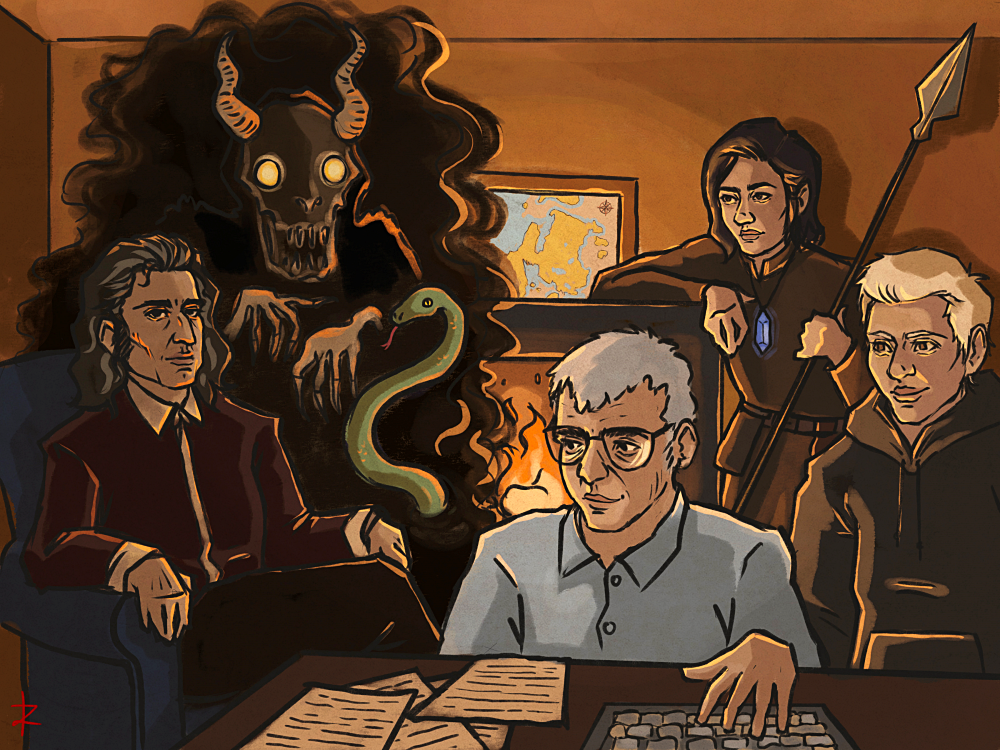
How do you like the family portrait that now adorns the top of this page?

Yes, that is myself sitting at the keyboard, no doubt diligently writing away on the next literary masterpiece. I have to say the picture flatters me. It’s now clear that I should have always been an animated character.

I’m surrounded by none other than the renowned Demon Hunter Orpheus (a.k.a. Septimus Bridge), the renowned actual demon Astaroth (a.k.a. The Fiend), and the last two Demon Hunters in the world (as far as we know) Izanami (a.k.a. Chiharu Ito) and Sapphire (a.k.a. Lola Blumquist). You will know them all from reading The Curse of Septimus Bridge and its sequel Last of the Tuath Dé. I like how the human beings are looking vaguely impatient, as if they can’t wait to see what ordeals they are going to be put through next. Meanwhile, The Fiend appears over-eager, as if he’s the one who’s going to have all the fun. All the while, I seem to be cracking a wee bit under all the pressure.

The artwork is by Tamlyn Zawalich, the same talented illustrator who produced the images for the covers of the two Demon Hunters books. It was organized as a birthday surprise by my wonderful friend Dayle, who is not only responsible for making my books read as coherently as they do but who saves my bacon with fixes, corrections and suggestions and who encourages every possible drop of quality in the final drafts.

My friend Michael once suggested that I should turn the Sapphire/Izanami tales into a graphic novel. I was immediately open to the idea, and I’m even more so now.

Maybe, though, we need to extend the saga a bit more first. If you agree, then I have good news. Writing has begun on the sequel to the sequel. I’m only on Chapter 1, but that’s where I always begin.

There has been a longer break than usual (about a year and a half) between the publication of my last book and starting the next one. I had a couple of other projects in between as well as a couple of film festivals to attend, and then it was the distracting Christmas season which, where I live, always seems to run from late October to mid-January. This is the time of year when I usually get most of my serious writing done—even more so when there is pandemic along with government-mandated lockdowns in effect.

There is no lockdown in effect at the moment, but we did have a couple of storms. Last weekend these islands were buffeted by two named storms, Isha and Jocelyn, within a three-day period with us being located in the red zone for the former. We were without electricity for a night and a day, and with phones’ and other gadgets’ batteries running down, I was eventually left without the internet but still had a fully charged laptop to work with. There was actually nothing else I could do except make things up in my head and type them out. It was as though the universe forced me to start the next book.

So yes, the next book is definitely a continuation of (addition to? complement of?) the world of Septimus, Sapphire, Izanami and all the other characters in my own little fantasy world (see illustration above). My other ideas for books—including a story set entirely in Ireland and even also possibly one that returns to the world of Dallas Green—are still out there, but they will wait and gestate a while longer.

So, where does the story—actually multiple stories—go from where we left off at the end of Last of the Tuath Dé? I have an outline, but experience suggests many things could change by the time I’ve finished fleshing it all out. Some of the familiar characters will be back, and there will also be new characters.

So, where does the story go? Let’s find out together.

Wednesday, November 22, 2023

Don’t Take My Kodachrome Away

  When I had taken all the obvious pictures, I just started pointing the camera around the beach zooming in on things that might be interesting. I was zooming in on a palm tree when I realized that there was someone sitting against it. I zoomed in closer. And I actually gasped. It was a girl. But not just any girl, but the most beautiful girl I had ever seen in my whole life.
  —Maximilian and Carlotta Are Dead, chapter 6 (“Meeting Mary Loneliness”)
I have always wondered what it would be like to meet one of my novels’ characters in real life. You know, like in some fantasy meta scenario in a movie written by Charlie Kaufman. Of course, things like that don’t happen in real life, but I had the next best thing happen last week. I came across a photograph of one of my characters.

I was going through a box of old papers and documents that had been in our garage since we moved here 22 years ago. It was stuff that got thrown into boxes after leaving various jobs over the years in the Seattle area. Suddenly my eyes got hit by a blast from the past. It was a page from a calendar, specifically February 1985, consisting mostly of a photograph. It was a freebie from a vendor in the suburb Tukwila, and it came with a lot of info on the back, including lots of details about the photographer/designer as well as the customer graphic coordinator. It was printed on a four-color Heidelberg GTOVP52 printing press, and the paper was 80-pound Eloquence cover. It was the fourteenth “in a continuing series of designer calendars.” It even gives the name of the model in the photograph and where it was shot: Puerto Vallarta, Mexico.

What prompted me to hold onto it? Well, look at it. I think I was in love. I could say I was in love with the idea of a beach in Jalisco, of the sand, the tropical trees, the soft warm light, the margaritas that were probably being mixed just out of frame, but why bother? You’ve already judged me.

Long after I had forgotten that this artifact was in my distracted possession, the image endured in my mind. When I knew that I was going to write about an 18-year-old kid from California meeting a young woman on a beach in Sonora and taking her photo, I knew that this was the photo he would be shooting. It was as though my novel Maximilian and Carlotta Are Dead were a true story that occurred in a parallel universe and Dallas Green’s photo of María Soledad Carvajal somehow traveled through time and space to land in my Seattle place of employment in 1985.

Maybe I held onto it for the same reasons that, in that parallel universe, Dallas held on to it.
  And then there were the pictures of Marisol. Photo after photo showed her leaning back against that palm tree on that beach, throwing her head back, laughing at me and smiling that smile that made me fall in love with her. But now I was seeing something I hadn’t seen before. Something like a trace of sadness underneath the laughter. I had seemed to strike a chord when, in my ignorance, I translated her name as Mary Loneliness. Just when I had started to think that the whole business with her had been some sort of temporary insanity, here she was back and making me fall in love with her all over again.
  —Maximilian and Carlotta Are Dead, chapter 19 (“Partings”)
Not all of my characters’ physical aspects are so vivid in my mind. When first conceived, they might start out looking like someone I know in my own personal life, but they quickly take on a life of their own and morph into a completely new person with their own distinct appearance. Marisol, though, remained consistent and faithful to that 1985 photo.

Only when I finally brought Marisol back in my post-trilogy coda, the short story “Rendezvous,” did she mature and age. Still, it didn’t diminish her beauty. I’m sure of it.
  “Marisol?” Valérie’s gaze deepened. “And he met you in Mexico?”
  “Yes, in a seaside town called Guaymas.”
  After a long pause, Valérie said, “No, he never mentioned you.”
  “There is no reason why he should have. It was so long ago…”
  “I did see your photo once, though.”
  “My photo? How…?”
  “I recognize you now. Obviously, you were much younger then, but it was definitely you.”
  “He had a photograph of me?”
  “Yes. I saw it only briefly. You were on a beach. Leaning against a palm tree. You had a book open on your lap.”
  “That’s right. He did take a photograph of me on the beach. And he kept it all those years?”
  “Once when we were living in Paris, he left a book on a table. I picked it up to see what he was reading, and the photo fell out. It had been between the pages. He blushed when I teased him about it. I asked him why he was hiding a photo of such a young girl. He did not want to talk about it. I could see it was several years old. The colors had begun to fade. Still, it was a nice photo. It made… an impression on me.”
  —“Rendezvous” (short story)

Saturday, September 16, 2023

Back to Deauville

  “Yes. Tell me, are you familiar with the Deauville Film Festival?”
  “Dough ville? Uh, no.”
   “Deauville is in Normandy. For six years now they have been holding a film festival there dedicated to American cinema. And this year you will be attending. What do you think of that?”
  “I, I don’t know what to say. This is kind of the last thing I expected.”

In Chapter 12 of Lautaro’s Spear, our protagonist Dallas Green gets thrown a curve. Out of the blue his boss tells him he’s being sent along with a reporter to take photographs at a film festival in France. It turns out to be a godsend because Dallas needs an escape from his chaotic life in 1980 in San Francisco where his affair with a married woman is unraveling disastrously and his friendship with a drummer in an aspiring rock band has turned a bit weird.

  The weather was very much like San Francisco with a cold, stiff breeze bearing down on us. The terrain was a lot flatter though. I could smell the ocean even if I could not see it. I had the distinct impression it was not very far ahead of us. We stopped in front of a large and impressive building that looked like some sort of castle with high windows and columns at the front entrance.
  “This is the Casino,” she said, pronouncing it “ca zee no” the way the French would say it. “This is where we will be tonight for the opening.”

At the time I wrote Lautro’s Spear, I had never been in Deauville. I had lived in France for a year as a student many years previously, and I had visited Normandy then and since, but I had no actual memories of that particular vacation spot to draw on. I had to rely on research and imagination in describing Dallas’s impressions of the place.

“So, how accurate did your research turn out to be?” asked an extremely affable taxi driver named Benoît. He was driving us to Le Havre to catch a ferry back to Ireland. Benoît had rescued us five days earlier when an unreliable local bus system had left us stranded in the delightful town of Honfleur. I had told him about my novel and that I was keen to see how good a job I had done in conjuring the place without actually having been there.

After a major birthday several months ago, I decided it was finally time to follow in my fictional alter ego’s footsteps and experience the Festival du cinema américain de Deauville myself—43 years after Dallas had been there. Accompanied by wife and daughter, I spent a glorious five nights and four days attending the film festival. Of course, in four decades much had changed. The main venue for the big events is now the elaborate CID (Centre international de Deauville) situated between the Casino and the town’s fabulous beach. The beach itself looked exactly like every photograph I had ever seen of it with its iconic colorful umbrellas on the wide expanse of sand and the boardwalk that functions as a virtual walk of the stars with famous movie names adorning the long line of beach cabins.

We made a stop at one famous name, that of Clint Eastwood. He was at the 1980 film festival to screen his movie Bronco Billy and is one of several real-life attendees mentioned in my novel. In fact, he has sort of a walk-on cameo. On Eastwood’s beach cabin was a poster highlighting the fact that his son Kyle had participated in the opening night festivities of this year’s festival, marking the release of his album Eastwood Symphonic, dedicated to the music of his father’s movies. An accompanying documentary Eastwood Symphonic: A Family Affair was also screened during the week. If I had been better organized, I might have tried to crash the event in an effort to make contact with Kyle and shove a copy of Lautaro’s Spear into his hand. Instead, I dropped by the festival office and left a copy with two staffers who were quite gracious upon learning about the book’s existence and receiving a copy.

It was a strange experience seeing the hotel where Dallas stayed during his time there and where he first spotted the love of his life, Valérie Destandau. And to walk along the beach where the two of them strolled one night and she first mentioned her boyfriend back in Bordeaux. While there, I enjoyed much warmer weather than Dallas did. I’m pretty sure I checked the weather records and found that it would have been cool early in that September of 1980. Anyway, that is how I described it. Benoît sort of verified as much when he told us that the warm weather we came into was in stark contrast to the cool, wet weather of the previous week.

  “I almost forgot,” he said. “There were some photos on one of your film rolls. They were of a woman. Nobody here recognized her. We thought they might have been for your personal use.”
  I took the envelope into the darkroom for privacy. I knew immediately what photos they were, and I wanted to look at them alone. One by one I pulled them out of the envelope and stared. The sight of Valérie’s laughing face was more than I could bear. There she was on the beach in Deauville in the darkness of the evening. She looked embarrassed and amused at the same time. It was the evening she taught me the word galoche. I missed her so much. I loved her so much.

I will have to re-read chapters 16 through 23 more carefully to determine what mistakes or misrepresentations I might have inadvertently made. Benoît suggested that I might want to release a revised edition of the book. Hopefully, it won’t come to that.

If you would like to know some more about my visit to Deauville, particularly the movies I saw there, I invite you to read my recent post on my movie blog.

Monday, April 24, 2023

Indy Selling Success Story

Things to have come full circle in the book business—well, at least in my book business. When I published my first novel nearly nine years, I didn’t bother with a paperback version. I had bought into the hype and buzz that told us that print books were dead or dying and that the future was digital.

Then, after hearing from a surprising number of potential readers that they wouldn’t be reading Maximilian and Carlotta Are Dead until they could do so on paper, I corrected my course. Three months later the paperback version (with a new more printer-friendly cover) was released. Ever since, the digital and paper versions of my novels have been released simultaneously.

Despite the stubborn (determined?) paper readership out there, however, most of my sales were digital, specifically via Amazon Kindle. In the past year or two, though, that has changed. Maybe it had something to do with Covid or perhaps with the type of people who read fantasy books like The Curse of Septimus Bridge and Last of the Tuath Dé, but print books have been making up a larger share of purchases. As far as I can tell, print is definitely not dead.

In January I informed readers of this blog that I now have my own sales portal at Bookshop.org for paperbacks. The beauty of that site is that it offers the same stay-at-home-and-have-it-delivered convenience of any other online seller, but it also offers readers the possibility of supporting authors they like or any of the hundreds and hundreds of independent brick-and-mortar book stores that have also signed up with them.

I have lately learned more about the history of and philosophy behind Bookshop.org thanks to a great article by Kate Knibbs posted on Wired magazine’s website a couple of weeks ago. As chronicled in that piece, it was the brainstorm of Andy Hunter, who ran a midsize literary publisher called Catapult. The profile describes his sometimes difficult childhood and how the local library became a place of solace for him.

Hunter became obsessed by a random comment he heard over dinner from a board member of the American Booksellers Association: what if ecommerce was a boon for independent bookstores, instead of being their existential threat? That led him to propose converting the association’s IndieBound program, which promoted independent booksellers, into an alternative online bookseller.

The association wasn’t interested in that approach but offered Hunter support if he wanted to start his own online bookshop. The beauty of his concept was that neighborhood bookshops and authors can get money for selling books online with a minimum investment of time and effort, as Bookshop.org takes care of inventory and shipping by partnering with wholesaler Ingram. I suppose another way to look at it is that Bookshop.org is an online seller like any other except that it generously shares its profits with local bookstores and authors.

Hunter’s timing turned out to be fortuitous because of the pandemic, as loyal local bookshop customers couldn’t get to their favorite sellers in person. Even without an advertising budget, its growth has been spectacular. Knibbs’s article recounts small bookshop owners’ stories of the cash windfalls that bailed them out of disasters thanks to having opted into Bookshop’s earnings pool fueled by 10 percent of the operation’s sales.

It’s an inspiring story, and a great lesson of what can be accomplished in the capitalist system when people approach business with good intentions.

      * * *

You may have been wondering what I’ve been up to in the eight months since Last of the Tuath Dé was released. I can tell you that I have been writing but not much more than that. I’ve been working on something that is a departure for me, in that it’s speculative, it’s non-fiction, and it’s got a personal angle.

If anything comes of it, and I’m hopeful it will, you will be the first to learn about it here.

And yes, I plan eventually to continue the saga chronicled in The Curse of Septimus Bridge and Last of the Tuath Dé.

Sunday, January 15, 2023

Same Books, New Portal

Something on this blog has changed.

At the top of this page, if you click on any of the three links for my own online bookstore Afranor Books, they will now take you to a different place than they did before.

It was only two years ago next month that I announced that I had become an online bookseller. As I acknowledged back then, calling myself a bookseller was something of an exaggeration. Ingram, the company that prints the paperback versions of my novels and distributes them to sellers, had encouraged its authors to set up their own online shops. For this purpose, they provided the portal (called Aerio), and we authors set up (within limits) the design and inventory. It was another way for readers of particular authors to find and buy their books.

Then a few days before Christmas, Aerio informed us that it was getting out of the authors-selling-books business. What? It seemed like I had only just set up my bookshop, and now I was being evicted?

The Aerio online storefronts will close down at the end of this month. If for some reason you need or want to visit my Aerio site before it vanishes, here (for the final time) is the link to it: shop.aer.io/AfranorBooks.

Aerio further suggested, if we wanted to continue to have a place (besides, of course, all the other online booksellers out there) to direct readers to purchase our books, that we consider Bookshop.org! Coincidentally, mentioned that site on this blog back in August when discussing issues with some of the more prominent online sellers.

As I wrote then, “They provide centralized ordering, delivery and customer service for a network of local independent bookstores. They are mostly in the US, but recently they have begun expanding internationally, specifically in the UK and Spain. Their website claims they’ve raised nearly $22 million for local bookstores.”

“This is how it works,” I continued. “On their website you select a local bookstore (there are more than 1,400 to choose from) you want to support. Once you’ve done that, any online orders you make from the website are fulfilled by Bookshop.org and the local bookstore gets 30 percent of the retail value.”

It turns out that Bookshop.org has an affiliate program for authors like me, so rather than giving up having my own online portal altogether, I have set up shop over there.

You can check it out by clicking this link: bookshop.org/shop/afranorbooks. Or any of the three other links (can find all of them?) at the top of this page.

Note: unlike the Aerio site, which sold both paperback and digital versions of my books, my Bookshop.org page just sells paperbacks. So, if you are looking for my novels as e‑books, you will want to select from among the many sellers of digital (and print) books listed along the right-hand side of this page.

Monday, December 19, 2022

Hand of Maradona

  To my surprise Donal called out after him, “Just for the record, mate, you lot most definitely stole the World Cup.”
  He stopped in his tracks and turned to face us.
  “The cast on van de Kerkhof’s wrist was completely illegal,” he said with annoyance.
  “Bollocks. You were stalling for time. You were doing anything you could to throw the Dutch off. You had your own referees, and they were so one-sided it was a bloody joke.”
  “What the hell are you two talking about?” I asked.
  “The 1978 World Cup. It was here in Argentina, and they bloody well stole it.”
That exchange from Chapter 14 of Searching for Cunégonde is about the first time Argentina won the World Cup in 1978. It is between Dallas Green’s English friend Donal and Alberto, one of a number of people the pair encounter in Dallas’s quest to find his long-lost friend Antonio. As they anticipate the next World Cup, Alberto tells Donal to watch out for an up-and-coming player named Maradona. Of course, Alberto has the full benefit of this author’s hindsight, but in fairness the young Maradona’s promise would have been apparent to most Argentine sports fans.

That promise would be borne out eight years later in Mexico when Argentina won its second world soccer championship thanks to Diego Maradona and his “Hand of God” goal and his “Goal of the Century.” I reflected on that two years ago when Maradona died suddenly at the age of 60.

For Argentina’s third World Cup trophy, it would have to wait until, well, yesterday. This time the World Cup was held (somewhat controversially) in Qatar, and it was Lionel Messi (born the year after Argentina’s previous most recent championship win) who led his country to victory in a knuckle-biting match with penalty shoot-out for the ages. I would like to think that, somewhere out there Alberto and Donal are still around and were watching like 14.9 million other viewers. Alberto would, of course, be crazy with joy over the triumph of his team, called la Albiceleste for its colors. Donal would be disappointed that England’s team (called the Three Lions for its insignia) crashed out at the quarter-final stage. Perhaps, though, he would take some consolation that his team did pick up the tournament’s Fair Play Award.

In other life-sort-of-almost-imitates-art news, Chile’s Láscar volcano rumbled back to life a bit more than a week ago. That wasn’t a complete surprise, as it is one of the most active volcanoes in the northern Chilean Andes. It is 38 miles from the Licanabur volcano, which isn’t believed to have been active for the past thousand years—and as far as I know still isn’t.

As readers of Last of the Tuath Dé will know, the interior of Licanabur is where the Grisial was created and is the the weakest point between our world and Tír nAill, otherwise know as the Otherworld and home of the Old Ones.

Speaking of Last of the Tuath Dé and Searching for Cunégonde, as well as my other novels, if you are stuck for gift ideas with only a few shopping days left until Christmas, books definitely make nifty presents.

Happy Holidays!

Tuesday, November 8, 2022

Colonel Mustard’s Return?

I have always loved the tone, quality and entertainment value of readers’ letters to The Times (“of London”). It was sort of a dream come true for me nearly a year ago when a letter of mine was actually printed in that newspaper—though it was “only” in the paper’s Irish edition. (In case you’re wondering, I was exhorting readers to sample as many diverse news sources as possible—even ones they might disagree with—in the interest of avoiding information blind spots.)

I didn’t actually sit down and write the letter on a piece of paper and then drop it in a mailbox. It was originally a comment on an article on the Times web site, and an editor contacted me to verify my identity and to ask for permission to use it in the print edition. I don’t know if anybody actually writes letters to the editor on paper anymore. My guess is it’s all electronic now.

There was a good example yesterday of a classic Times reader’s letter or, rather, comment. It was beneath an article about new information on an old murder case suggesting the crime did not happen spontaneously but, in the words of an investigator, “it makes me think the whole thing was pre-planned.”

The most highly rated comment (with 114 recommendations as of this writing) on the article: “Isn’t planning pre-planning?” Say what you want about Times readers, but they care about the language.

You may wonder why am I am taking up space with all this on my book blog. It’s because the presumed murderer in the article was a certain Lord Lucan. He has been an object of fascination for the UK (and by extension the Irish) media since he vanished without a trace in 1974. This was immediately after his wife and his children’s nanny were attacked with a lead pipe. The wife survived, but the nanny, who was attacked first in a basement kitchen, died.

The newly revealed information is that three Cluedo game cards were subsequently found in a Ford Corsair that Lord Lucan had borrowed and which was found abandoned at Newhaven in East Sussex, suggesting he may have taken his life by leaping into the sea. The cards matched ones missing from a set owned by the lord. Which cards were they? Colonel Mustard, the lead pipe and the hall. Like Lord Lucan, the fictional Colonel Mustard is a former military man with a mustache. How very Agatha Christie.

The article further reveals that subsequently a woman insisted to police that she later met Lord Lucan at a party at a villa in the Algarve in Portugal. Today’s Irish Independent (like The Times, drawing from original reporting from The Daily Mail) informs us that a facial recognition expert, using AI photo analysis, has made what he claims is a 100-percent match between photographs of Lord Lucan and an 87-year-old pensioner in Australia. If they’re not the same man, says Professor Ugail, then they’re certainly identical twins.

On the other hand, my own neighbor here thinks I solved the mystery five years ago with the release of Lautaro’s Spear. His first comment after reading the book was that “you should have never killed off the other fella.” (He never forgave me for the demise of his favorite character from Maximilian and Carlotta Are Dead.) His second comment was, “We finally know what happened to Lord Lucan.”

The name of the infamous lord (born Richard John Bingham) never appears in Lautaro’s Spear, but in Chapter 3 Dallas Green and his friend Linda go to a restaurant called Balthazar’s in San Francisco where their waiter is a dapper Englishman named Richard. Later in Chapter 13 Dallas has a chat with Marty, the mysterious proprietor of a hole-in-the-wall Mexican restaurant in the Mission District. Dallas is taken aback when Marty brings up Balthazar’s.
  “You would be surprised at the interesting stories lots of ordinary-seeming people have in their pasts. Here’s an interesting one. You ever been in a restaurant near Union Square called Balthazar’s?”
  “Yeah…” I said suspiciously.
  This was a perfect example of the weirdness that went through my conversations with Marty. Balthazar’s was the only restaurant in that area I had ever been in. What were the odds of that?
  “There’s a waiter there. His name is Richard. He’s an English guy.”
  “Yeah, he waited on a friend and me.”
  “You don’t say? Well, don’t tell anyone where you heard it, but that guy is a murderer.”
  “You’re joking, right?”
  “It’s true. I swear it.”
  “If you know this for sure, shouldn’t you tell the police or somebody?”
  “Nah, there’s no need for that. He only killed one time, and he won’t ever do it again. He was a British lord back in England—and a professional gambler—but things just didn’t go well for him. He was separated from his wife and children. One night he slipped back into the house and killed the nanny. Beat her to death with a lead pipe. Poor girl wasn’t even supposed to be working that night. Not sure if he mistook her for the wife or if she just got between him and the kids. Anyway, he took off and no one has heard of him since.”
My guess is that this exchange, which has absolutely no bearing on the rest of the book’s narrative (other than to establish Marty as a man with unusual connections and mysterious sources of information), went right over the heads of most readers. It would take someone, like my neighbor, who would be the right age and who lives on this side of the Atlantic to pick up on that reference. I believe this is what is known as an Easter egg.

Speaking holidays, it’s only 48 more shopping days until Christmas, so it behooves me to point out all the links on this page that will lead you to places to buy all kinds of great holiday gifts, including not only Lautaro’s Spear but also the other Dallas Green books as well as The Three Towers of Afranor, The Curse of Septimus Bridge and my newest tome, Last of the Tuath Dé.

Tuesday, October 11, 2022

Stamp of Approval?

In a generous gesture to honor a humble writer residing on its soil, Ireland’s national postal service, An Post, has released a new commemorative stamp in honor of Last of the Tuath Dé.

Okay, actually not. I only wish.

It’s just an interesting coincidence that, at the beginning of September, An Post issued stamps featuring the mythical namesake of one of my latest novel’s characters. As the official blurb explains, the stamp is “based on Balor, a legendary figure in the Formorian supernatural race in Irish mythology.” It continues:
    According to the Irish folklore tales, Balor caused great pain and anguish to the Tuatha Dé Dannan, the other supernatural race in Irish folklore.
   The legend centres on Balor having an eye that, when unleashed, could cause instant death or poisoning. Balor’s Poisoned Eye is the main focus of one stamp. The second stamp relates to the legend that claimed Balor had only to look on the landscape to cause damage, such as in the Poisoned Glen in County Donegal.
   In both cases, contemporary colours are used to create the impression of poison almost leaping off the stamp.
A domestic postage stamp depicts Balor’s Evil Eye, while an international one illustrates the Poisoned Glen. They are part of PostEurop’s collection of stamps across Europe celebrating this year’s theme of Stories & Myths. The collection includes a whole array of mythical and legendary figures from various European countries.

Other examples include Saint Hubertus from Belgium, the mermaid Melusina of Luxembourg, the Bogeyman of Bosnia and Herzegovina, Emperor Charlemagne of France and Switzerland’s William Tell. Who knew that post offices could be such a great source for potential character names for future fantasy novels?

To be clear, the authentic mythological Balor does not actually appear in Last of the Tuath Dé. That Balor is my own creation, inspired by the Irish myths. The narrative conceit is that the Tuath Dé and the Fomóire in my book were the true inspirations for the Irish stories—even though in the real world it’s the reverse that’s true.

Quite a coincidence that An Post would be highlighting Balor within just a couple of weeks after the release of Last of the Tuath Dé, eh? But wait, it gets better.

It so happens that Greece’s entry in the Stories & Myths stamp collection is none other than Orpheus. As my readers will well know, Orpheus is the Demon Hunter name—or as Hadrian the Necromant would dashingly put the term (see Chapter 12), nom de chasseur de démon—of none other than the title character of The Curse of Septimus Bridge. Sadly, the two Greek stamps depict Orpheus’s demise as he’s about to be ripped to shreds by the Thracian Maenads for having forsaken his former deity patron Dionysus in favor of the sun god Apollo. A further reminder, if any were needed, that it’s always a bad idea to tick off a Greek god.

That’s a fate even worse than being trapped for eternity in the Netherworld.

Sunday, October 2, 2022

Who’s Who?

Madame Bovary, c’est moi.

That is what 19th-century French novelist Gustave Flaubert is reported to have replied when asked if the title character of his best known novel, Madame Bovary, was based on a real person. He himself was she, he said.

That seemed strange when I first heard it lo these many years ago in my student days. How could a 37-year-old bachelor writer, who was a frequent customer of prostitutes, base a young, sheltered, convent-educated female character obsessed with romantic novels on himself? Now, however, it makes perfect sense to me.

I once read or heard from a source that seemed authoritative that, when we dream, all the people in our dreams are versions of ourselves. We might think we dreamt about a friend or relative, but it was really us. I don’t know if that’s true, but it sounds like it might be. I suspect something similar goes on with creators of fiction. I find it plausible that the inner lives of every fictional character is essentially an extension of that of its creator.

These thoughts are prompted by my previous post in which I anticipated—and shot down—the question of whether the character Antonio, who features in Maximilian and Carlotta Are Dead and its two sequels, was based on my longtime Peruvian friend Mañuco. If I think about it for very long, the real basis for Antonio becomes obvious. Antonio, c’est moi. Or more appropriately, Antonio soy yo.

No, of course, I’m not—and never have been—an abandoned Mexican street kid living by my wits on the streets of Los Angeles. But look past that. Antonio is an avid reader of comic books. He loves movies and the Spanish language. If you read Chapter 10 of Max & Carly carefully, you’ll even find circumstantial evidence that he’s a fan of the 1960s gothic soap opera Dark Shadows. The case is open and shut.

A lot of readers, including those who personally know me well, have assumed that it is the narrator Dallas who is me, and to be sure I did make Dallas’s circumstances close to my own—even to the point of having him be born in the same month and year. That, however, was to make it easy for myself in terms of getting the history right and to minimize my own need for research. What can I say? I’m basically lazy. But why waste time denying whether or not I’m Dallas? I’ve already bought into the idea that all my characters are me.

If that’s true, this has interesting implications for a literary debate that raises its head from time to time. Is it some kind of inappropriate appropriation for a male writer to attempt conveying the female experience through a fictional character? For a white fiction writer to write at length about the African-American or Hispanic experience?

For that matter, what about a California-born, straight, Scandinavian-American, male writer attempting to portray in fiction a Japanese-Canadian bisexual woman who happens to be a Demon Hunter? Yes, I had to bring the conversation around to my latest book, Last of the Tuath Dé, lest anyone forget that it is still out there and available for purchase.

Basically, I feel about fiction-writing the way I feel about the acting profession. In principle, any artist should be able to portray any character in any medium. In practice, though, it doesn’t cost me or anyone else anything to try being sensitive to legitimate issues people may have when it comes their own experiences and to history. In the end, though, my philosophy in artistic matters is to err on the side of creative freedom.

If I have my own escape clause for slipping through the imagined tentacles of the so-called political-correctness police, it is that I am either writing fantasy or else focusing on what I know personally—and none of my characters are meant to emblematic or representative of an entire group of people. I’m just telling stories.

That is why I feel secure in proclaiming, Izanami et Sapphire, ils sont moi.

Saturday, September 24, 2022

Traduttore, no Traditore?

Sometime during the past few days, as I write this, my words are being or have been read out at a poetry festival. This is not something that occurs for me often. In fact, virtually never.

But wait. Are they really my words being read out? That’s a fertile subject for discussion.

You see, I have this friend. I met him years ago when I was making my way home from a year’s study in Chile and found myself with several hours to kill during a layover in Lima. Through a series of events too complicated to go into right now, I wound up being invited to his family’s home for Sunday dinner and to pass the time until my evening flight to Los Angeles. Despite a significant gap in our ages, Mañuco (as he was called within the family) and I hit it off and formed a friendship that has endured through decades, marriages, parenthood and international relocations. He has lived many years in Paris, while I have dwelled these past score of years in rural Ireland. He is a poet, designer, dancer, all-around artist and general purveyor of Peruvian culture in the City of Lights.

If his name rings a bell with my readers, it is probably because he was one of the people to whom I dedicated my very first novel. And in case you are about to ask, no, he is not Antonio, the young traveling companion of Dallas and Lonnie in Maximilian and Carlotta Are Dead whose presence also weighs heavily in the two subsequent novels. Of course, any insights I gained from having a friend from a different (specifically, Latin American) culture informed the fictional character, but Antonio himself was more directly inspired by various Mexican and Mexican-American friends and acquaintances I had in my younger days. Still, the long-lasting bond between Dallas and Antonio does echo that of Mañuco and myself.

My Paris-based friend has always been a spinner of poems, and he has always written them in his native Peruvian Spanish. For years he has submitted them to various academic and literary journals. Many of these journals require works submitted in languages other than English to be accompanied by an English translation. At some point he asked me to translate one of his poems, and always up for a challenge, I gave it a go. He was delighted with the result and happily submitted it along with the original version. Since then, these requests have become a somewhat regular thing.

To be sure, I undertook this job with no small amount of trepidation. For one thing, I am not trained as a translator. My Spanish is pretty good (if I do say so myself), but translation is a whole different skill from simply understanding and communicating in a foreign language. Translation requires a specialized sort of training. Furthermore, I can in no way be considered a poet. I do read and appreciate poetry and have even churned out the odd bit of doggerel when the occasion required, but I am totally ill-equipped to write serious poetry of my own.

Despite this, I willingly produce translations of Mañuco’s poems because, for one thing, he is happy with and grateful for them. For another thing, it just seems to work because of the long and unusual mental bond between him and me. It’s a wondrous thing, as he and I are products of such different cultures, are native speakers of different languages, are different ages, and have actually spent precious little time in each other’s company. The vast majority of our communication has been through letters and, later, emails and internet audio conversations. Despite all this, when I read his poetry, I have some kind innate understanding of what he’s thinking, something he himself confirms. I do have to do a lot of research, sometimes painstakingly word by word, to find the right words or phrases, but only rarely do I have to consult Mañuco directly about his intentions or nuances. I doubt I could do the same for any other writer.

Part of the challenge of Mañuco’s poetry for a translator is that is tends toward themes of nature, earthiness and ribaldry along with a serious dose of surrealism. He tells me that my translations are invariably well received, although once he delighted in telling me a submission resulted in feedback that went roughly like this: your poem is pornography, and your translator is even more pornographic than you. It was never made clear to me whether this was contained in a letter of rejection or acceptance.

From Mañuco’s point of view at least, the old Italian aphorism traduttore, traditore (translator, betrayer) does not apply. He insists my translations make me a poet in my own right. Personally, I’m not so sure about that. Translation is definitely an art, but I’m not convinced that the translation of poetry is itself a form of poetry. I confess, though, I don’t mind the flattery.

Poetry or not, though, my English version of Mañuco’s words are being read aloud this weekend—along with the original Spanish words—at the inaugural edition of La Tour Poétique organized by the Association Apulivre in Paris. Hopefully, no fastidious listeners will be offended.

I’m definitely more comfortable with prose. And speaking of prose, allow me again to thank those of you who have purchased and read Last of the Tuath Dé. While the sales numbers certainly pose no competitive threat to the likes of James Patterson and J.K. Rowling, I’ve been gratified by the numbers of people who have sought out the book at the various online stores. I’ve been particularly impressed by the numbers of people who have gone to the expense of buying the paperback version.

Thank you all. (A translation of gracias a todos.)

Monday, August 29, 2022

Time for a Cover Story

At a similar point as this three years ago, I shared some of the influences that went into creating the story of The Curse of Septimus Bridge. I also shared the unadulterated illustration that was featured on the cover.

Since I am all about consistency and tradition, let me now do the same for Septimus’s sequel, Last of the Tuath Dé. Embedded in this blog post is the original artwork that was provided for the book by the rather talented Tamlyn Zawalich, who also created the cover art for Septimus. I was delighted that she was willing and able to do the same for the new book. As I just recently said, I’m all about consistency and tradition. So you can see the two illustrations together, the original art for The Curse of Septimus Bridge is embedded in this blog post as well. Enjoy.

So what were my influences? Was it mainly Dark Shadows as was the case with Septimus? Well, there’s a bit of that, but this story doesn’t really do the Gothic schtick. There’s no old, mysterious house on a cliff with waves crashing on the rocks below. Well, at least except maybe for a page or two.

No, this time around my mind was infused with the creepy, otherworldly horror of H.P. Lovecraft. And now that I’ve mentioned him, let me just acknowledge that some people have been put off by Lovecraft because of certain things he wrote and certain beliefs he held. Fair enough, but the man is dead and buried, and in mentioning him, I only mean to honor the work that inspired me and which still exists—and not endorse everything said and done by a flawed man who is now dead and consigned to history.

On Last of the Tuath Dé’s dedication page, I acknowledge Lovecraft as well as his fellow early-twentieth-century pulp-fiction writer Robert E. Howard and also the immortal J.R.R. Tolkien, who is always in my head.

Who else is on the dedication page? The German guys behind the Netflix series Dark and French writer/photographer/filmmaker Chris Marker. I could have also included the many minds behind the venerable BBC series Doctor Who. Hmmm… what do all of those—and Dark Shadows for that matter—have in common? Well, if you’re familiar with them all, then probably something that comes to mind is time travel.

Does time travel exist in the Septimus/Tuath Dé world? The question was actually posed, though not answered, in Chapter 24 of The Curse of Septimus Bridge:
   As the three rested and shivered on the pier, Kyle could not stop laughing. “That was the coolest thing that’s ever happened to me! How did you do that, Lola? Was it hard? How does it work? Can you teach me? That was amazing!”
   Maria was less impressed. “Would you have a trick up your sleeve for drying us off or warming us up, like?”
    “Hey!” said Kyle. “Can you turn back time? That would be cool. What about time travel? Is that real? This is so unbelievably amazing.”
So is time travel real in this world? Spoiler alert: technically, no… but perhaps there are exceptions?

I’ve never been particularly interested in writing a time-travel story (though I obviously do love consuming ones created by others) because logic and coherence very quickly become trampled casualties unless you simply require readers to suspend disbelief and not ask too many questions. What does particularly intrigue me, though, is the way the aforementioned writers seriously attempt to deal with the logical—and emotional—consequences of time displacement.

By the way, if you want to see a good attempt at a complex but totally consistent time-travel movie (and on a shoestring budget), then Shane Carruth’s 2004 flick Primer is what you need. Its escalating paradox-on-conundrum narrative becomes mind-numbingly overwhelming.

Last of the Tuath Dé is not like that. I like to think it’s just a good old-fashioned adventure story with epic pretensions—and maybe with a bit of temporal inventiveness.

Oh yeah, and a really cool cover.

Wednesday, August 24, 2022

Shop Around

   “The journalists. They’ve been here the whole time. They know there was no terrorist attack. We came to rescue the child you kidnapped. I’ll tell them myself if I have to.”
   Izanami was bluffing, but it didn’t matter. Bob only laughed.
    “Do you think they’d listen to you? Who do you think pays their salaries?”
    “You own a television network?” asked Sapphire.
    “No, but a good friend of mine does. Another owns a major newspaper. Others own the main social media sites. We’re all united in the effort to save the planet.”
    “Do you know what you’re supporting?” asked Izanami. “Do you understand what this whole thing is really about?”
    “I know there’s no point in having one of the largest chunks of net worth in the world if I don’t use it for something monumental, something to fundamentally change history. If you want to debate specific merits, Alaric’s your man. He’s the vision guy.”
One of the characters in Last of the Tuath Dé is a tech billionaire who is the head of a software company. As evidenced in the excerpt above, a fellow tech billionaire friend of his owns a newspaper and is apparently not adverse to suppressing or filtering information if it is in service for what he believes is a good cause.

Let me emphasize that these characters are fictional and exist only in service to the plot of a fantasy novel. If you want to consider whether anything remotely like this could happen or has happened in real life, that’s entirely up to you.

Still, I find myself wondering if someone at Amazon chanced to read that portion of the book and took umbrage. (In an entirely random and unrelated real-life coincidence, Amazon founder and chairman Jeff Bezos happens to own The Washington Post.) If they did, they shouldn’t have. That plot element was a pure invention of whimsy on my part in an effort to concoct an engaging story. Nothing more. No inference was intended about any real person, living or dead. That’s my story, and I’m sticking with it.

Why am I even pondering this question? Well, I’ve noticed some strange goings-on with the pricing of the paperback version of Last of the Tuath Dé on Amazon’s US website. The book’s price has gone through some gyrations, but generally has been well above the official suggested retail price. Also, if you want free delivery, you are told not to expect the book until September. Maybe this is because the default purchase choice is through a third-party seller. Actually, if you click through to the extended purchase choices, you do find that you actually can order it directly from Amazon at the SRP (with free Amazon Prime delivery) but you are told to expect it even later in September. Also, there is a whole range of other third-party with widely varying prices, some even offering used copies of the book—which blows my mind because the book has only been out now for a week and a half.

To be clear, this isn’t just happening with the new book, and this isn’t a new thing. But why? A possible clue may be found just beneath the bad news about prices and delivery times: “As an alternative, the Kindle eBook is available now and can be read on any device with the free Kindle app.”

It almost sounds as though Amazon would prefer you to buy the Kindle version rather than the paperback. Well, it’s hard to argue against the fact that it is indeed faster and easier to acquire and read the book on your Kindle device or app. And I am grateful to each and every reader who does that—and also to Amazon who has made that platform available. That’s how most of my books get sold.

At the same time, it’s interesting that the company seems to be discouraging purchases of books printed by someone other than themselves. You see, I could have Amazon print those paperback versions of my book that are sold through Amazon. Many author/publishers do just that because it means less hassle and delay for their paperback readers. I, on the other hand, have chosen to have all copies of my paperbacks—whether sold by Amazon or not—printed by a single company (it’s called Ingram) simply because the quality is better. I don’t feel that disadvantages buyers of my book (well, too much anyway) because, unlike Kindle readers, paperback readers aren’t locked into a single seller. Actually, Kindle readers aren’t either, but it’s more hassle for them to buy a digital book from someone else and then get it loaded onto their device or into their app.

So, my advice is that if you are a person who prefers to read my (or anyone else’s) books in paperback form, then shop around. There’s a whole choice of sellers over on the right-hand side of this page as well as many others out there. For example, you can buy paperbacks from my own Afranor Books—at least if you’re in the US or Canada.


A more interesting option for you, though, might be Bookshop.org, which was launched at the beginning of 2020. They provide centralized ordering, delivery and customer service for a network of local independent bookstores. They are mostly in the US, but recently they have begun expanding internationally, specifically in the UK and Spain. Their website claims they’ve raised nearly $22 million for local bookstores.

This is how it works. On their website you select a local bookstore (there are more than 1,400 to choose from) you want to support. Once you’ve done that, any online orders you make from the website are fulfilled by Bookshop.org and the local bookstore gets 30 percent of the retail value.

Given where I live, I haven’t had an opportunity to try out their service yet, but as described, it sounds like a pretty good idea to me. You get the convenience of online browsing and ordering while at the same time knowing that the cozy, friendly neighborhood bookshop down the road just might survive so that you can still drop in to them in person from time to time to do real-world browsing.

Sounds like a win-win to me.

Sunday, August 21, 2022

A Question of Order

Besides questions about the title, the most common inquiry I get about the new book is this one. Since it’s a sequel, is it absolutely necessary to read the first book, The Curse of Septimus Bridge, first?

Allow me go into analytical-personality mode and say, no, there are no laws on the books or anything else that would prevent you from reading the second book without first having read the first one. It’s not as though you have to swear an affidavit or pass some kind of knowledge test about Septimus in order to be issued a copy of Last of the Tuath Dé. Of course, people aren’t really asking if it’s possible to read one without having read the other. They want to know if it’s a good idea.

At least half the answer to that question depends on you, but I can do my best to fill in the other half, which may help you do your half.

People like me, who have a compulsive element to their personality, prefer to read things in order. If there is a series of books, movies or television episodes, I want to read or view them in the order they were created. Or maybe in whatever order keeps the overarching narrative chronological. Or maybe not. I actually dealt with this conundrum 13 years ago on my movie blog when I pondered the question of whether a new viewer should watch the Star Wars movies beginning with A New Hope or The Phantom Menace. I came down on the side of experiencing the movies in the order they were created and in which the world originally experienced them, as opposed to following the saga chronologically.

So, if you’re that type of person, then the answer is clear. You should read Septimus Bridge first and Tuath Dé second.

But not everyone is that type of person. I’m not even that type of person all the time. Maybe the descriptions of the second book sound more interesting to you, and those of the first one not so much. Maybe you’re just not as interested in reading books that have been around awhile and you like your reading material to be new and fresh.

Still not sure? Here’s what else I can tell you. I wrote Last of the Tuath Dé, as I do all my books, with the intention that it stand on its own and be a complete and satisfying reading experience all by itself. Though many of the characters were introduced in the earlier book and events in that book have a bearing on occurrences in the new book, I did my best to bring new readers up to date without boring established ones. It’s a new story with its own beginning, middle and end. Though there are characters and events referred to—sometimes quite significantly—from the previous volume, that was also sort of true of the first book. People were referred to in that book whom we had not met, and prior events were mentioned that we had not experienced. That’s how I approach my storytelling. The characters are not born full-grown (like Athena emerging from Zeus’s forehead) the minute you start reading about them, and their lives don’t stop when you get to the last page. Yeah, if you read Tuath Dé first, you’ll be playing some catch-up, but there’s always catch-up to play with three-dimensional characters.

I made a deliberate choice not to organize any of my books as part of a series—even though that’s a particularly trendy thing to do these days, particularly when it comes to YA lit. I discussed this topic here in some detail five years ago when I declared that the Dallas Green books—and now, separately, the Septimus/Sapphire/Izanami books—are part of a novel sequence rather than a series. That kind of gives readers permission to read the books in whatever order they want.

So, here’s the bottom line. If it were I, I would read Septimus first, but if for whatever reason, you really want to just read Tuath Dé, I think you’ll be okay.

For what it’s worth, my beta readers didn’t find the question any easier to answer than I have—and for the same reason. It’s hard, if not impossible, to put yourself in the place of someone who hasn’t read something that you’ve read. Even people who had read the first book didn’t necessarily remember all the detail of it anyway.

And here’s something else. A couple of those early readers said they thought that Tuath Dé was a better book than the first one. On the other hand, at least one other preferred the first one. In case we needed reminding, choosing what to read and when—and whether we’re happy with those choices—is very individual and pretty darn subjective.

Of course, my wish is that you will read both books and in fact all my books—in whatever order you prefer—and that you will enjoy them.

Thursday, August 18, 2022

Two a Day

What else can I tell you about the new book?

One source of additional information might be the interview I did with myself on my movie blog. I won’t repeat that experience here because I’ve learned that self-interviews can quickly turn weirdly passive-aggressive. Also, I addressed the question of whether there is political satire in the book in my expat blog if you’re interested in that. As for this blog, let’s spend some time dealing with other questions that potential readers might have. For example, what is the meaning of the book’s title?

To give them their full name, the Tuatha Dé Danann were a supernatural race of beings in Irish mythology. The name translates as the people or folk of the goddess Danu. She was a primordial mother goddess. Tuath Dé is an older name for them, and it translates as tribe of the gods.

These beings dwelled in the Otherworld, but they did interact with mortal people. Their enemies were the Fomorians, or the Fomóire in old Irish or the Fomhóraigh in modern Irish. Disclaimer: Despite a couple of decades in this country, I make no claim to be an expert on the Irish language (or on anything Irish for that matter), as my wife and daughter are all too eager to remind me. If you want more authoritative information, do your own research.

To be clear, my book is not actually about the Tuath Dé of genuine Irish tradition. My book’s mythology is my own invention, though I obviously used themes common in most mythologies. As for the names of my supernatural beings, I borrowed (okay, appropriated) them. This is explained in Chapter 9 when an old Master tells Izanami and friends about the Old Ones:
  “Is that what’s happening now?” asked Izanami. “Are the Old Ones coming back?”
  “Perhaps,” said the old woman gravely.
  “All of them?” asked Peter. “Or just the ones who wanted to get rid of us. You know, the bad ones. Are they coming back? Sorry, do the two circles have names?”
  “Whatever names they have for themselves are beyond our ability to conceive and enunciate, so we have had to invent our own names for them. The most useful names to have survived down through the ages are in the Irish language. It is in that tongue that the old stories have come closest to surviving intact. That’s not to say that the Irish legends weren’t embellished or combined with other historical events, but it’s their names that have been adopted by Masters who research the lore. …”
I suppose the novel’s title could be misleading, especially for people who have some familiarity with Irish legends and might be hoping for a treatment of that subject. On the other hand, people with a particular interest in the Mexican emperors Maximilian and Carlotta, the Chilean freedom fighter Lautaro or Voltaire’s literary heroine Cunégonde could well have been similarly disappointed by the titles of my other books.

The main thing to know about the Tuath Dé, at least when it comes to the mythology in my book, is that among the Old Ones the Tuath Dé are the good guys—and we are apparently down to the last of them. Who or what is the last of the Tuath Dé? Well, finding that out is pretty much the point of reading the book.

Never mind the meaning of Tuath Dé, though. The first question I usually get when someone sees the title is… how do you pronounce it?

This too is dealt with (sort of) in Chapter 9:
  “So to answer your question, lad, the circle of Old Ones that wanted to purge the universe of humans is called the Fomóire. The entity which guides them—their leader if you will—is called Balor. Many are the legends that have survived of Balor of the Evil Eye. We call the other circle—the ones who argued for our survival—the Tuath Dé.”
  “The ‘two a day’?” asked Peter.
  “Not too bad an attempt at the pronunciation.”
Young Peter is not given any further instruction on the pronunciation, and I suspect most readers may be happy enough with the “two a day” approximation. (It’s also not a bad target frequency for mixing evening martinis for oneself.)

If you really want to know the correct pronunciation, don’t expect me to embed an audio clip with me pronouncing it on this page. As mentioned above, the women in my house have done their best to forbid me any attempt at pronunciation of Irish words or names. My efforts only seem to hurt their ears. (This is quite a blow to the ego of someone who has gotten many compliments on his pronunciation of Spanish and even French over the years.)

The best I can do for you is to transcribe the pronunciation of Tuath Dé in the International Phonetic Alphabet. In Old Irish, it’s [t̪uaθa d̪ʲe]. In Modern Irish, it’s [t̪ˠuə(hi) dʲe] in Connacht and Ulster, and [t̪ˠuəhə dʲe] in Munster.

If you don’t want to get that technical about it, the New York-based website IrishCentral.com, which styles itself the news hub for the Irish diaspora, in an article titled “The Tuatha De Danann: Were they Irish gods or aliens?” offers a simpler pronunciation: “Thoo-a day.” Personally, to my ear, though, names beginning with “tu” (at least in my part of the country) sound like they begin with a “t” followed by a lightly aspirated “h” or even no “h” at all.

Yeah, probably easier for us Yanks to just stick with “two a day.”

Monday, August 15, 2022

Answering the Musical Question

Now that Last of the Tuath Dé has been released, I can’t wait to write and talk about it, you know, to give you some background and insights into the creation process.

First, though, it’s become sort of a tradition for me to share a Spotify music playlist to go along with the new book. My playlists for Lautaro’s Spear and The Curse of Septimus Bridge were basically collections of selected tracks that I listened to while I was writing those books, you know, to put me in the frame of mind for the time and place and mood. Then with my playlist for Searching Cunégonde I tried to do something clever (so often a mistake in my case) and strive to make the list of track titles match (as closely as possible anyway) the book’s table of contents. That definitely made for some interesting choices. Who knew it would be so easy to find songs called “Toque de queda,” “Querétaro,” “Paperasse” and “Algeciras” but impossible to find one called “Reports of a Murder”?

The following-the-table-of-contents thing was definitely not going to work for Last of the Tuath Dé—at least not for every chapter—so I opted instead for a track list that followed the book’s plot sequentially by including character names, chapter titles and themes—as well as the one song actually mentioned in the book itself. Needless to say, this provided ample opportunity to include a few of the surprising number of tunes out there that deal with the topic of the world ending. R.E.M. and Elvis Costello are just a couple of the myriad artists who have employed Armageddon as subject matter for songwriting. It also allowed me to sneak in a favorite Doctor Who track by Murray Gold.

So without further ado, I give you the official Spotify playlist for streaming while reading your copy of Last the Tuath Dé

Oh yeah, and if you want to try making your own musical playlist based on the book’s chapter titles, here they are…