After months of gnawing thirst, I have finally broken out the Writer’s Tears cask-strength Irish whiskey!
That’s right. I have finally released another book. My proof copy arrived today, and it didn’t look completely terrible. So it’s a go. My fourth novel is now out there in the various distribution channels.
It is called The Curse of Septimus Bridge, and this is the one I have been telling you about, well, for years. This is the Gothic romance/supernatural thriller/magical adventure yarn I have been meaning to write for practically my whole life. As I have oft described it, it is my homage to the 1960s daytime horror serial Dark Shadows. It is the book I always wanted to read, but never quite managed to find anywhere—at least not written the way I wanted it written.
My fellow Dark Shadows fans will recognize certain elements. Two young women find themselves in an isolated, creepy, old house under mysterious circumstances. There is a brooding figure with a dark, mysterious past. There is love—or something more sinister?—reaching from beyond the grave. There are lots of crashing sea waves.
But it is not just a knock-off or imitation of a Dark Shadows plot. It is ultimately an adventure saga and a tale about finding oneself. It is a story of friendships. It is about coming to terms with the past and then moving on toward the future.
This is my second fantasy novel, after The Three Towers of Afranor. Unlike that one, however, this takes place in our own recognizable world. I have managed to draw in two different places that are meaningful to me—America’s Pacific Northwest and the West of Ireland. I have also populated it with characters unlike the ones I have created for my other books.
You can find the paperback version of The Curse of Septimus Bridge right now on the Amazon and Barnes & Noble websites. It is also—or should be soon—available from all other major online sellers. I will do my best to keep the links on the right-hand side of this page updated.
As for a version you can read on your preferred digital gadget, right now is available from Amazon for Kindle devices and apps. Because the vast majority of my books’ readers have acquired them for Kindle, I have decided to exclusively with Amazon for the digital version—at least for the first three months. If I become aware of demand for Kobo, Nook, iBook, etc., I will consider supporting those as well when my arrangement with Amazon is up for renewal, but experience suggests we are in simply a Kindle-dominated e-book world. And Amazon just makes it so much easier to serve Kindle customers when you sell through them exclusively.
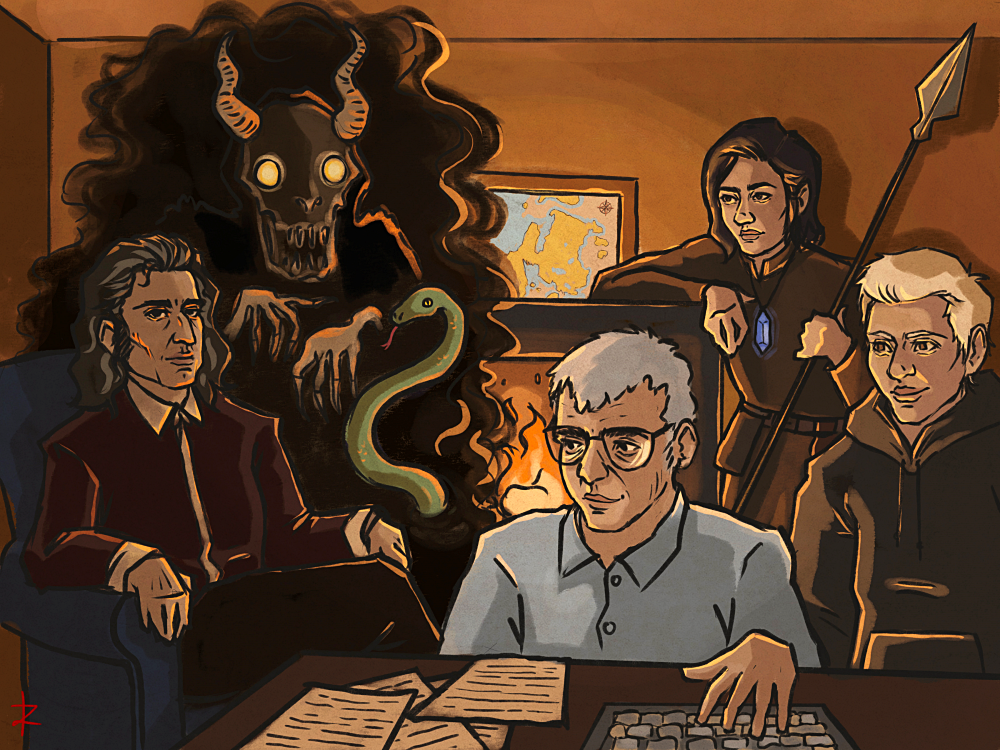
There is lots more to say about Septimus Bridge (did I mention I was excited about it?), but there will be time for that in the days and weeks to come. For now, I’ll just say how happy I am to have such a cool cover, which was created by the talented Tamlyn Zawalich.
Books available for purchase at Afranor Books on Bookshop.org and from Amazon and other major online booksellers
(If you are viewing this on a phone, you can see many more links to sellers by switching to this site's desktop version)
My Books
“I actually could not put the book down. It is well written and kept my interest. I want more from this author.”
Reader review of Maximilian and Carlotta Are Dead on Amazon.com

All books available in paperback from Afranor Books on Bookshop.org.
Friday, July 5, 2019
Wednesday, May 8, 2019
Haunted
As we ambled through the New Mexico desert, we talked about our favorite books.
We knew, all too sadly, this would probably be our last time with my cousin Trudy’s husband. What we did not know was that it would be our penultimate visit with Trudy herself. Thoughts like those, in any event, were not on our minds as we explored the Petroglyph National Monument outside Albuquerque in the January sun.
She wanted to know what novels were closest to my heart. The first few titles—The Lord of the Rings, One Hundred Years of Solitude—would have been unsurprising to her. Then I mentioned Emily Brontë’s Wuthering Heights, and there was an awkward silence. Trudy, an enrollee at Caltech the very first year they admitted women, would have been the last person to trade in gender stereotypes, so I had not expected her, after some hesitation, to say, “You do realize that would be considered a girl’s book?”
And suddenly I was back in junior high school. Back to a time when there were “boys’ books” and “girls’ books.” As far as I was always concerned, there were just books. Some books I liked, and some books I did not. Not everybody liked the same books I did, and I did not necessarily like the same books other people did. Maybe gender was a factor in some cases, but certainly not in all. All I know is that when I saw the cover of Brontë’s novel on a shelf in our local library, it appealed to me. There was a man and a woman and stormy weather. There was passion. I read the first several pages, and there was a ghost. What was not to like?
This should come as no surprise to readers of my movie blog, who have suffered through more than two decades’ worth of discussions and reminiscences of the 1966-71 Gothic soap opera Dark Shadows which, to be honest, was nothing if not a half-decade-long rehash of Wuthering Heights and every other Gothic novel and supernatural story ever published. Readers of that blog may also think they detect a disconnect, since I have sometimes used that forum to dismiss certain movies as “chick flicks.” The truth is, though, that I have always intended that term as descriptive shorthand—so that readers would know what to expect from a film—rather than as a definitive put-down. If that phrase is a criticism, it is of a too-strict adherence to formula and not because the story includes female characters or might appeal to female viewers.
My fourth novel, which should see the light of day in the coming weeks, is among other things my tribute to the Gothic novel. It is a story I have been wanting to get out of my system for most of my life. It is also my first book to feature a female protagonist. In fact, I have only recently realized that this is the first of my books to pass the Bechdel Test. Originally a gag in a 1985 comic strip, the test was originally aimed at movies but has since been generalized to apply to all popular fiction. It requires the work to have at least two (named) female characters who have a conversation about something other than a man. It is not something that is usually on my mind when watching movies, let alone when I write my novels, but it comes as no surprise to realize that my first three books came nowhere near passing the test. For one thing, two of them have a male first-person narrator.
The other, The Three Towers of Afranor, while narrated in the third person, follows its male protagonist relentlessly. Ironically, though, it probably would have passed if only I had followed the suggestion of a (male) friend who was keen for me to work in a quasi-erotic wrestling match between the warrior princess Eilís and the pirate queen Valloniah. Those two would only have needed to mutter a few words to each other in the heat of battle—and on a topic other than their lone mutual acquaintance, Prince Chrysteffor—to clear the bar. But would that really be in the spirit of the standard popularized by Alison Bechdel? Maybe. Personally, I find such a test interesting but not particularly useful or practical.
It was definitely a challenge to create and give life to characters who are not only female but also of a generation different from mine, but that was not the reason for this particular story. It was to spin a supernatural romance my own way. As usual, I ignored all writing conventional wisdom by not targeting a distinct target audience—other than myself. As always, I wrote a book that I wanted to read. Is the result a “girl’s book” or a “boy’s book”? When you are writing for yourself, that question happily becomes moot.
Sadly, my cousin passed away within mere days of the publication of my first novel, so she never got to read any of my fiction. Given her nature, I imagine she would have been supportive but not uncritical. I also doubt she would have labeled it a “girl’s book.”
We knew, all too sadly, this would probably be our last time with my cousin Trudy’s husband. What we did not know was that it would be our penultimate visit with Trudy herself. Thoughts like those, in any event, were not on our minds as we explored the Petroglyph National Monument outside Albuquerque in the January sun.
She wanted to know what novels were closest to my heart. The first few titles—The Lord of the Rings, One Hundred Years of Solitude—would have been unsurprising to her. Then I mentioned Emily Brontë’s Wuthering Heights, and there was an awkward silence. Trudy, an enrollee at Caltech the very first year they admitted women, would have been the last person to trade in gender stereotypes, so I had not expected her, after some hesitation, to say, “You do realize that would be considered a girl’s book?”
And suddenly I was back in junior high school. Back to a time when there were “boys’ books” and “girls’ books.” As far as I was always concerned, there were just books. Some books I liked, and some books I did not. Not everybody liked the same books I did, and I did not necessarily like the same books other people did. Maybe gender was a factor in some cases, but certainly not in all. All I know is that when I saw the cover of Brontë’s novel on a shelf in our local library, it appealed to me. There was a man and a woman and stormy weather. There was passion. I read the first several pages, and there was a ghost. What was not to like?
This should come as no surprise to readers of my movie blog, who have suffered through more than two decades’ worth of discussions and reminiscences of the 1966-71 Gothic soap opera Dark Shadows which, to be honest, was nothing if not a half-decade-long rehash of Wuthering Heights and every other Gothic novel and supernatural story ever published. Readers of that blog may also think they detect a disconnect, since I have sometimes used that forum to dismiss certain movies as “chick flicks.” The truth is, though, that I have always intended that term as descriptive shorthand—so that readers would know what to expect from a film—rather than as a definitive put-down. If that phrase is a criticism, it is of a too-strict adherence to formula and not because the story includes female characters or might appeal to female viewers.
My fourth novel, which should see the light of day in the coming weeks, is among other things my tribute to the Gothic novel. It is a story I have been wanting to get out of my system for most of my life. It is also my first book to feature a female protagonist. In fact, I have only recently realized that this is the first of my books to pass the Bechdel Test. Originally a gag in a 1985 comic strip, the test was originally aimed at movies but has since been generalized to apply to all popular fiction. It requires the work to have at least two (named) female characters who have a conversation about something other than a man. It is not something that is usually on my mind when watching movies, let alone when I write my novels, but it comes as no surprise to realize that my first three books came nowhere near passing the test. For one thing, two of them have a male first-person narrator.
The other, The Three Towers of Afranor, while narrated in the third person, follows its male protagonist relentlessly. Ironically, though, it probably would have passed if only I had followed the suggestion of a (male) friend who was keen for me to work in a quasi-erotic wrestling match between the warrior princess Eilís and the pirate queen Valloniah. Those two would only have needed to mutter a few words to each other in the heat of battle—and on a topic other than their lone mutual acquaintance, Prince Chrysteffor—to clear the bar. But would that really be in the spirit of the standard popularized by Alison Bechdel? Maybe. Personally, I find such a test interesting but not particularly useful or practical.
It was definitely a challenge to create and give life to characters who are not only female but also of a generation different from mine, but that was not the reason for this particular story. It was to spin a supernatural romance my own way. As usual, I ignored all writing conventional wisdom by not targeting a distinct target audience—other than myself. As always, I wrote a book that I wanted to read. Is the result a “girl’s book” or a “boy’s book”? When you are writing for yourself, that question happily becomes moot.
Sadly, my cousin passed away within mere days of the publication of my first novel, so she never got to read any of my fiction. Given her nature, I imagine she would have been supportive but not uncritical. I also doubt she would have labeled it a “girl’s book.”
Subscribe to:
Comments (Atom)


