My Books

“I actually could not put the book down. It is well written and kept my interest. I want more from this author.”
Reader review of Maximilian and Carlotta Are Dead on Amazon.com 

Afranor Books

All books available in paperback from Afranor Books on Bookshop.org.
See below on the right-hand side of this page for links to other sellers.
Afranor Books

Thursday, August 8, 2019

Over the Hill

I have a problem with genres. I think I pretty well established that back when I wrote about how I could not get my head around the idea of the popular YA (Young Adult) genre. Having done that, of course, I then inexplicably went on to write what is to all intents and purposes a YA novel.

The Curse of Septimus Bridge is my second fantasy novel. The first one was The Three Towers of Afranor. Was it also a YA novel? I suppose, although it is not really like most of the examples I have seen of the YA genre. What is the difference between Afranor and Septimus? Well, mainly it boils down to the fact that Afranor takes place in an imaginary world (spoiler alert: it’s called Afranor) and Septimus takes place in our own recognizable world, specifically in Seattle, Vancouver, London, and Galway. But they both involve magic and the supernatural.

How do they differ from what I call my “odd” novels? Those are Maximilian and Carlotta Are Dead and Lautaro’s Spear, and I refer to them as odd not because they are strange or unusual but because in the order my books have been written those are the ones which have numbers not evenly divisible by two. And in what genre do my odd novels fall? Well, there’s the rub. Depending on the context I have variously designated them as “adventure,” “coming of age,” “historical fiction,” and my personal favorite catch-all category, “literary fiction.”

If I were clever, I would have used a pseudonym for my fantasy novels. I am sure it is confusing for people wanting to pigeonhole me as a particular kind of writer to settle on what the “Scott R. Larson” brand is. But I do not use a pen name. I use the same name for everything I write. If you pick up a Scott R. Larson novel at random, you do not know what you are going to get. Kind of like Forrest Gump’s box of chocolates. It might be about something about dragons and sorcerers. Or it might be something about 18-year-olds driving to Mexico in an old Chevy.

If I had planned things correctly, the name Scott R. Larson would be clearly identified exclusively with literary fiction and Bildungsromans, while if you were seeking a good fantasy book, you would know to look for the name (I just found this on an online random-author-pseudonym generator) Griffin Opel Johnson. Would you be more likely to pick up The Curse of Septimus Bridge if it was written by Griffin Opel Johnson? I know I would.

So there are drawbacks to using one’s own name on one’s own books. There are also drawbacks to using real places—as I did in Septimus—in your book as opposed to just making up places—as I did in Afranor. For example, if you set your book in Seattle, you run the risk of some reader writing to tell you, “Hey, there is no Metro bus running from that street to that other street.” Or “There is no possible way you can sail from Shilshole to such-and-such place in just a couple of hours.”

It gets even trickier if you start using places in the West of Ireland. For example, my wife—who never reads my book until after they are actually published—was aghast to find some local place names mentioned. “You are going to draw Satanists on us,” she insisted. “The neighbors won’t like that.” You never hear people in Seattle complain about Satanists being drawn on them.

In particular Cnoc Meadha, an imposing hill in County Galway, gets singled out as a specific point of earthly contact with the demon world. Do people in the area mind me tagging that place with an unhallowed reputation? No one has complained yet, but that could well be because they have not seen the book. Personally, I think they might actually welcome some notoriety. There is an ongoing Knockma Hill Project (Knockma being the common modern version of the hill’s name) to implement improvements and a new trail. The project is driven by the Caherlistrane-Kilcoona Community Council and funded by a grant under the Town and Village Renewal Scheme supplemented by the local Community Council. Additional money was raised by a Christmas concert in December by well-known singer and musician Seán Keane and his band.

Publicity can help raise money, and no publicity is bad publicity, right?

The accompanying photos were taken at Knockma during a morning walk a few weeks ago. For the record, no demons were encountered.

Friday, July 26, 2019

Art of the Novel

I have lived with The Curse of Septimus Bridge for about fifty years now. And no, that’s not an exaggeration. Like the title character, I am literally from another century.

The book’s title is relatively new, but the story goes back a long ways. And in a sense, it actually predates me. I frankly admit there is little original in it other than my own personal worldview and sensibilities and literary filter. As I acknowledge in the dedication, a lot of the story ideas are heavily influenced by my beloved 1960s supernatural Gothic soap opera Dark Shadows. Viewers of that series will know well that the literary lineage does not stop there. Creator/producer Dan Curtis populated his show with plots from all kinds of horror/supernatural literary classics—everything from Bram Stoker’s Dracula to Mary Shelley’s Frankenstein and Henry James’s The Turn of the Screw, Daphne du Maurier’s Rebecca, Shirley Jackson’s “The Lottery” and many more.

If fans of Doctor Who want to focus on the fact that the title character is from another time and takes on a young companion with her own mystery, well, I will not dissuade you from that line of thinking either.

On top of all that, some events and people in the book are actually real, that is, they are from history. My fictional characters do sometimes interact with people who actually lived.

Finally hitting the page, it is quite a different story in 2019 than it was in the 1960s and 1970s, at least in terms of the characters. Its soul may be in the Victorian age, but I have tried to put its feet squarely in the 21st century.

Having kept quiet about the story during the actual writing of the book, which only happened over the past couple of years, I stored up a lot of things I wanted to share about my thoughts and intentions and where the inspiration for a particular thing came from. The irony is that, by this point, I have already moved on mentally. The next installment of Dallas Green’s story beckons. Moreover, I am hesitant to give away too much about the story (not a great strategy for selling books, I know) because, if I were now reading it for the first time, there are things I would not want to have spoiled. Still, I will see if there are a few more things I can safely share.

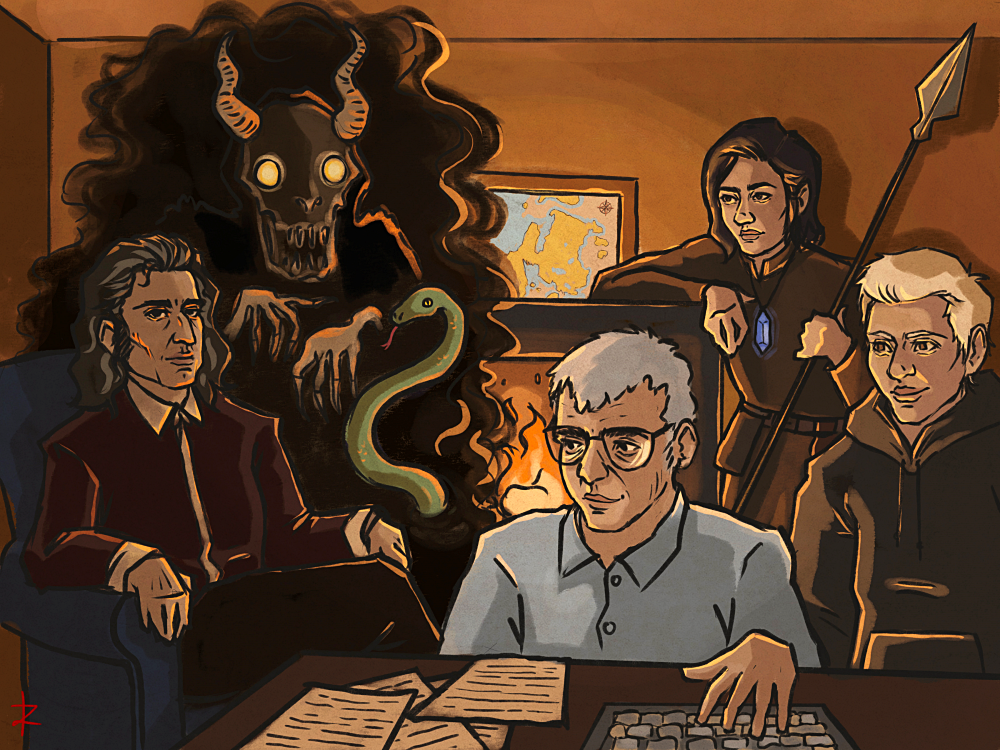
One thing I can share is my excitement over the cover art. The artist’s name is Tamlyn Zawalich, and I was so delighted when I first saw her work that my immediate reaction was to regret that some of it would inevitably have to be covered up with boring, distracting things like the book title and my own name.

So that you have the same pleasure that I did and do not have to try to imagine the original illustration, I share it with you here. Enjoy.