My blogs have sadly languished—some more than others—during the past while. As the world emerged in fits and starts from various pandemic lockdowns, distractions multiplied and time for writing became scarcer. Unlike 2020, which provided lots of quiet, uninterrupted time for clicking on the old keyboard, the year 2021 has provided somewhat less. I ended up prioritizing novel writing over blogging.
I reached a milestone last week. Only a few days shy of the first anniversary of the release of my fifth novel (Searching for Cunégonde, in case it’s slipped anyone’s mind), I finally reached the end of my rough, first draft of the sixth book. Don’t get too excited. That only marks more or less the midpoint—effort-wise if not exactly timewise—of the work involved in producing the novel. As much effort again will be involved in rewriting, polishing, correcting, adjusting and refining.
Having said that, there’s no small amount of relief in typing those (for now) final words on Chapter 31. It means I can—actually, have to—put the story out of my mind, do my best to forget it and think about other things. The idea is that, when I go back to it, I will be seeing it with fresh eyes and will read what I actually typed rather than what I hoped or thought or imagined I did.
The first pass of the manuscript and the subsequent work are very different experiences. Up till now the work has been creative (or so I hope), i.e. plotting the thing out, conjuring up characters, trying to make it all fit together so it makes some kind of sense and yet come off seeming like all things just sort of happened. The next phase is easier in the sense that the creative decisions have mostly all been made but harder because, well, because the creative decision have mostly all been made. It takes a bit of mental stamina to go over what you’ve written over and over and over and then over again.
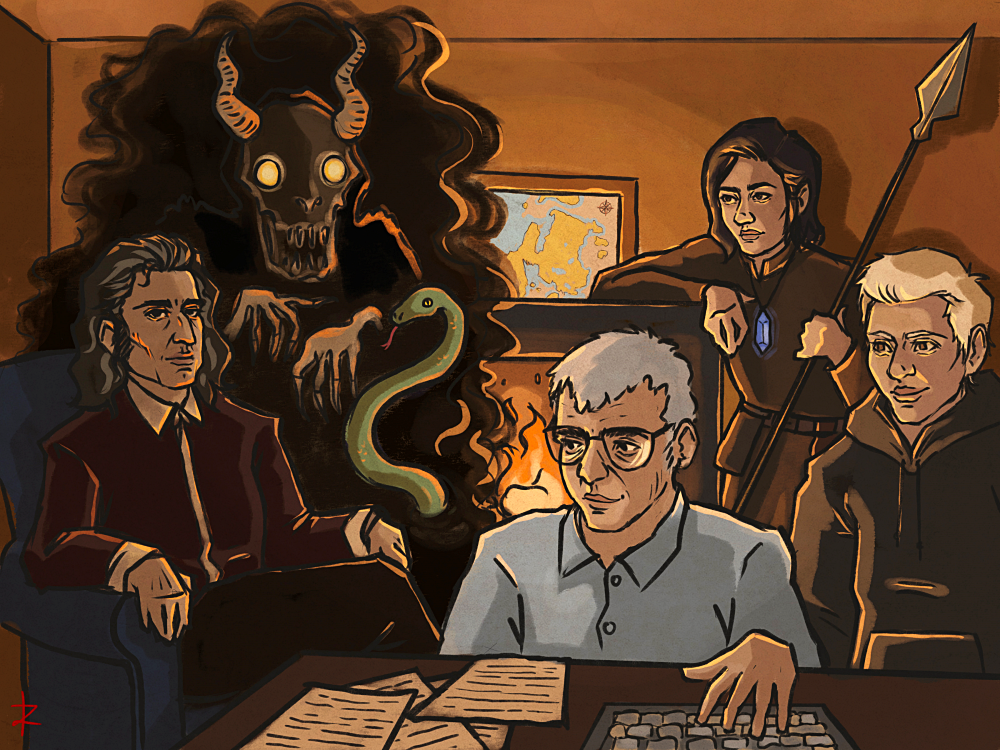
So what’s the book about? I think I may have already mentioned in this space that it is a direct sequel to The Curse of Septimus Bridge. What else can I tell you? Well, it mostly focuses on the demon hunter Izanami. We see most of the action through her eyes and point of view. We get to know her a whole lot better than we did in the previous book, including her history and how she came to be a hunter of hellions. We explore her relationship with Sapphire, the main character of the previous book, quite a bit.
Do other characters from the Septimus book return? Yes! Not all of them, obviously, but several of them. Some appear only briefly. Others feature more prominently than you might have expected. Quite a few new characters turn up, including some only mentioned or hinted at in the previous tome. There is fair bit of building on and expanding the lore and mythology of Izanami and Sapphire’s world. The action jumps around to many different far-flung points on the globe.
If The Curse of Septimus Bridge was my heartfelt homage to the TV series Dark Shadows, then its sequel is something of an attempt to indulge in my fascination for the work of H.P. Lovecraft, and I’d be lying if I tried to deny that it is also influenced by the mood and fantasy and craziness of Baran bo Odar and Jantje Friese’s marvelous 2017-2020 German series Dark. Like that series—and also the original Septimus book—it is at heart a love story. Most of all, though, my aim is to entertain (myself, but hopefully readers as well) and have a bit of fun.
What else can I tell you? Probably nothing useful. After all, this book is still a long ways from being released into the wild. In the meantime I promise to try to share snippets, hints and teases from time to time of what you may expect.
My Books
“I actually could not put the book down. It is well written and kept my interest. I want more from this author.”
Reader review of Maximilian and Carlotta Are Dead on Amazon.com
All books available in paperback from Afranor Books on Bookshop.org.
See below on the right-hand side of this page for links to other sellers.
Monday, September 27, 2021

Monday, August 9, 2021
Cwazy Wabbits
“Do you hunt, Dallas?”That exchange is from Chapter 32 (titled “Rabbit Hunting”) of Searching for Cunégonde. Just to clarify for those who have not read the book, Dallas did not have a hare problem—or a rabbit problem either. His problem had to do with human beings—and maybe his own mind—but that is another story.
“Not for years, Father.”
“I called earlier to Eamon Geraghty. He’s not been well, poor man. He was a great one for shooting hares, but I think that’s all past him now. I asked him for the loan of his gun. I told him you might have a hare problem up your way. He said you could keep it a while.”
“Father, I don’t think…”
“Just have it in the house. You never know.”
“Well, okay, if it makes you happy. I haven’t done any rabbit hunting since I was a kid. My friend Lonnie and I used to go out in the scrubland and shoot at jackrabbits.”

Because the book is narrated by Dallas, I felt free to let him mix up rabbits and hares the way a lot of people do. In my case—and Dallas’s—the confusion may be more pronounced because of where he and I come. In that part of California hares are called jackrabbits. But a jackrabbit is not technically a rabbit. Hares and rabbits are different species, though they both belong to the family of animals known as Leporidae. In that way, their relationship to each other is analogous to that of goats and sheep. Hares are larger than rabbits and have longer ears and bigger hind legs. Unlike rabbits, hares are born fully developed with fur and open eyes. Also unlike most rabbits, they do not burrow and so live above ground and not in warrens.
I am by no means an expert on these animals, but I do observe hares at fairly close range in the spring and summer. In fact, this year they have been particularly conspicuous in our garden. I think they are doing this to punish me for being so lax in describing them in my novel.
One in particular has nearly become a pet. I first spotted him (since he is not in a position to communicate his preferred pronouns, I have assigned them to him myself) one morning in the front garden. He was just a brown furry mass in the middle of the grass. I didn’t know what it was and approached close enough to verify it was an animal. Since it did not move or flinch no matter how close I approached, I assumed it was dead. After I had opened our gate, I went back to the house for my phone to snap a photo. That is when he decided he’d had enough and bolted.
For a couple of months we would see him out there at all hours, chewing on grass and weeds. He was strangely defiant and would hold his ground when I got near him. He was different from other hares who usually take flight at the slightest unexpected sound. Sometimes we wondered if he was extremely trusting of humans or just deaf.
Hares are actually quite entertaining to watch, especially in the spring when they jump every which way as if they’re totally flummoxed by everything. I guess that’s where we get expressions like “mad as a March hare” and “harebrained.”

He was not the only creature of his kind around. We spotted others, sometimes seeing as many as three at a time, but it was only our special friend who was regularly and prolongedly visible. For a while he was reliably positioned every morning in front of my dressing room window, as if waiting for me to raise the shade. Sometimes, when we returned home late at night, he and a friend would dart back and forth in the light of the car’s headlamps as we drove around to the back of the house.
In literature hares and rabbits are sometimes portrayed as pests. Think Beatrix Potter’s Peter Rabbit or, more relevant to my generation, Bugs Bunny. In fact, when I wrote about old Eamon Geraghty above, I sort of pictured him as an Irish Elmer Fudd. We ourselves would never contemplate violence toward our cohabitating hares. They usually don’t bother the flowers, and only once was one caught chomping on the strawberries. The hares are certainly much less destructive than the cattle or sheep that sometimes break through the fence to visit our garden.
Interestingly, as sometimes happens on the internet, there has been a longstanding debate going on as to whether Bugs Bunny is a rabbit or a hare. It would seem obvious since he has a cotton tail, lives underground and is frequently called “a wascally wabbit.” On the other hand, the color of his fur and the speed at which he runs suggest a hare. Moreover, an awful lot of his cartoons, going all the way back to the first one (depending on your view of which cartoon features the first true Bugs, it is either “Porky’s Hare Hunt” or “A Wild Hare”), have the word hare in the title: “Hare Brush,” “Fallin’ Hare,” “Bill of Hare,” “Lighter than Hare.” On one occasion he could be heard crooning, “I dream of Jeannie, she’s a light brown hare.” Come to think of it, Warner Bros. has a lot to answer for when it comes to rabbit/hare confusion.
Come to think of it some more, life growing up in the San Joaquin was sometimes not unlike living in a Warner Bros. cartoon. When driving the hot desert back roads of the eastern valley, one not only saw jackrabbits but also roadrunners.
As we enter autumn (according to the farmers here, August is the first month of autumn), we see less of our furry little friend, but he is still around. You just have to get up earlier in the morning or else watch for him in the dusky evening. He’s bigger and more mature now. Not the little wild hare he was in March.
Subscribe to:
Posts (Atom)