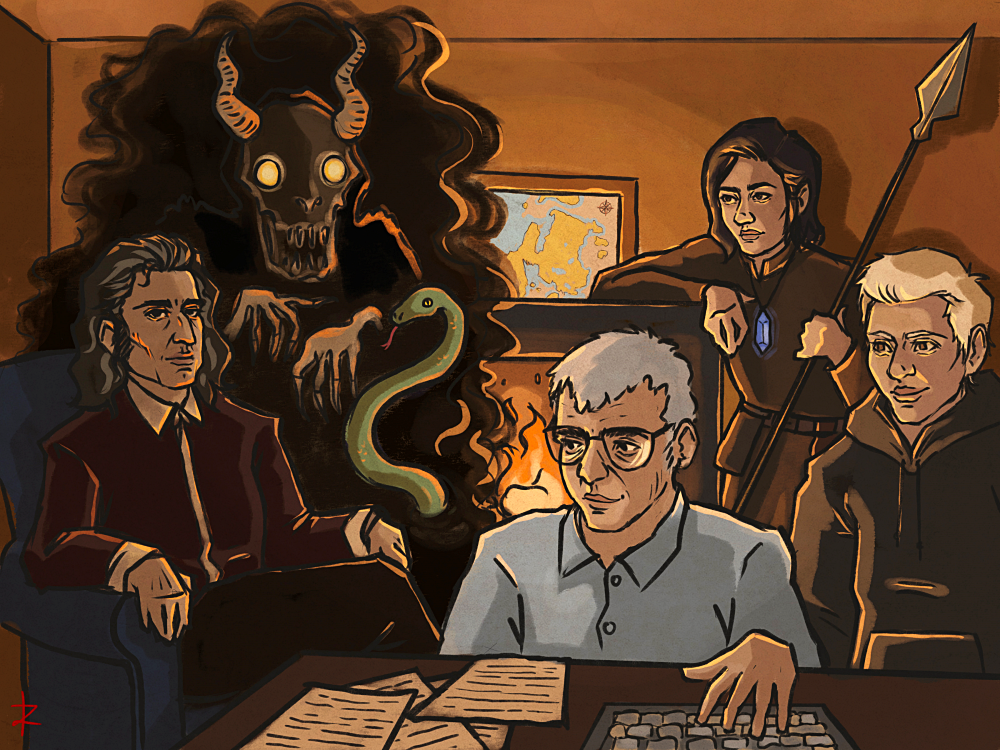
“The journalists. They’ve been here the whole time. They know there was no terrorist attack. We came to rescue the child you kidnapped. I’ll tell them myself if I have to.”One of the characters in Last of the Tuath Dé is a tech billionaire who is the head of a software company. As evidenced in the excerpt above, a fellow tech billionaire friend of his owns a newspaper and is apparently not adverse to suppressing or filtering information if it is in service for what he believes is a good cause.
Izanami was bluffing, but it didn’t matter. Bob only laughed.
“Do you think they’d listen to you? Who do you think pays their salaries?”
“You own a television network?” asked Sapphire.
“No, but a good friend of mine does. Another owns a major newspaper. Others own the main social media sites. We’re all united in the effort to save the planet.”
“Do you know what you’re supporting?” asked Izanami. “Do you understand what this whole thing is really about?”
“I know there’s no point in having one of the largest chunks of net worth in the world if I don’t use it for something monumental, something to fundamentally change history. If you want to debate specific merits, Alaric’s your man. He’s the vision guy.”
Let me emphasize that these characters are fictional and exist only in service to the plot of a fantasy novel. If you want to consider whether anything remotely like this could happen or has happened in real life, that’s entirely up to you.
Still, I find myself wondering if someone at Amazon chanced to read that portion of the book and took umbrage. (In an entirely random and unrelated real-life coincidence, Amazon founder and chairman Jeff Bezos happens to own The Washington Post.) If they did, they shouldn’t have. That plot element was a pure invention of whimsy on my part in an effort to concoct an engaging story. Nothing more. No inference was intended about any real person, living or dead. That’s my story, and I’m sticking with it.
Why am I even pondering this question? Well, I’ve noticed some strange goings-on with the pricing of the paperback version of Last of the Tuath Dé on Amazon’s US website. The book’s price has gone through some gyrations, but generally has been well above the official suggested retail price. Also, if you want free delivery, you are told not to expect the book until September. Maybe this is because the default purchase choice is through a third-party seller. Actually, if you click through to the extended purchase choices, you do find that you actually can order it directly from Amazon at the SRP (with free Amazon Prime delivery) but you are told to expect it even later in September. Also, there is a whole range of other third-party with widely varying prices, some even offering used copies of the book—which blows my mind because the book has only been out now for a week and a half.
To be clear, this isn’t just happening with the new book, and this isn’t a new thing. But why? A possible clue may be found just beneath the bad news about prices and delivery times: “As an alternative, the Kindle eBook is available now and can be read on any device with the free Kindle app.”
It almost sounds as though Amazon would prefer you to buy the Kindle version rather than the paperback. Well, it’s hard to argue against the fact that it is indeed faster and easier to acquire and read the book on your Kindle device or app. And I am grateful to each and every reader who does that—and also to Amazon who has made that platform available. That’s how most of my books get sold.
At the same time, it’s interesting that the company seems to be discouraging purchases of books printed by someone other than themselves. You see, I could have Amazon print those paperback versions of my book that are sold through Amazon. Many author/publishers do just that because it means less hassle and delay for their paperback readers. I, on the other hand, have chosen to have all copies of my paperbacks—whether sold by Amazon or not—printed by a single company (it’s called Ingram) simply because the quality is better. I don’t feel that disadvantages buyers of my book (well, too much anyway) because, unlike Kindle readers, paperback readers aren’t locked into a single seller. Actually, Kindle readers aren’t either, but it’s more hassle for them to buy a digital book from someone else and then get it loaded onto their device or into their app.
So, my advice is that if you are a person who prefers to read my (or anyone else’s) books in paperback form, then shop around. There’s a whole choice of sellers over on the right-hand side of this page as well as many others out there. For example, you can buy paperbacks from my own Afranor Books—at least if you’re in the US or Canada.

A more interesting option for you, though, might be Bookshop.org, which was launched at the beginning of 2020. They provide centralized ordering, delivery and customer service for a network of local independent bookstores. They are mostly in the US, but recently they have begun expanding internationally, specifically in the UK and Spain. Their website claims they’ve raised nearly $22 million for local bookstores.
This is how it works. On their website you select a local bookstore (there are more than 1,400 to choose from) you want to support. Once you’ve done that, any online orders you make from the website are fulfilled by Bookshop.org and the local bookstore gets 30 percent of the retail value.
Given where I live, I haven’t had an opportunity to try out their service yet, but as described, it sounds like a pretty good idea to me. You get the convenience of online browsing and ordering while at the same time knowing that the cozy, friendly neighborhood bookshop down the road just might survive so that you can still drop in to them in person from time to time to do real-world browsing.
Sounds like a win-win to me.
