Things to have come full circle in the book business—well, at least in my book business. When I published my first novel nearly nine years, I didn’t bother with a paperback version. I had bought into the hype and buzz that told us that print books were dead or dying and that the future was digital.
Then, after hearing from a surprising number of potential readers that they wouldn’t be reading Maximilian and Carlotta Are Dead until they could do so on paper, I corrected my course. Three months later the paperback version (with a new more printer-friendly cover) was released. Ever since, the digital and paper versions of my novels have been released simultaneously.
Despite the stubborn (determined?) paper readership out there, however, most of my sales were digital, specifically via Amazon Kindle. In the past year or two, though, that has changed. Maybe it had something to do with Covid or perhaps with the type of people who read fantasy books like The Curse of Septimus Bridge and Last of the Tuath Dé, but print books have been making up a larger share of purchases. As far as I can tell, print is definitely not dead.
In January I informed readers of this blog that I now have my own sales portal at Bookshop.org for paperbacks. The beauty of that site is that it offers the same stay-at-home-and-have-it-delivered convenience of any other online seller, but it also offers readers the possibility of supporting authors they like or any of the hundreds and hundreds of independent brick-and-mortar book stores that have also signed up with them.
I have lately learned more about the history of and philosophy behind Bookshop.org thanks to a great article by Kate Knibbs posted on Wired magazine’s website a couple of weeks ago. As chronicled in that piece, it was the brainstorm of Andy Hunter, who ran a midsize literary publisher called Catapult. The profile describes his sometimes difficult childhood and how the local library became a place of solace for him.
Hunter became obsessed by a random comment he heard over dinner from a board member of the American Booksellers Association: what if ecommerce was a boon for independent bookstores, instead of being their existential threat?
That led him to propose converting the association’s IndieBound program, which promoted independent booksellers, into an alternative online bookseller.
The association wasn’t interested in that approach but offered Hunter support if he wanted to start his own online bookshop. The beauty of his concept was that neighborhood bookshops and authors can get money for selling books online with a minimum investment of time and effort, as Bookshop.org takes care of inventory and shipping by partnering with wholesaler Ingram. I suppose another way to look at it is that Bookshop.org is an online seller like any other except that it generously shares its profits with local bookstores and authors.
Hunter’s timing turned out to be fortuitous because of the pandemic, as loyal local bookshop customers couldn’t get to their favorite sellers in person. Even without an advertising budget, its growth has been spectacular. Knibbs’s article recounts small bookshop owners’ stories of the cash windfalls that bailed them out of disasters thanks to having opted into Bookshop’s earnings pool fueled by 10 percent of the operation’s sales.
It’s an inspiring story, and a great lesson of what can be accomplished in the capitalist system when people approach business with good intentions.
* * *
You may have been wondering what I’ve been up to in the eight months since Last of the Tuath Dé was released. I can tell you that I have been writing but not much more than that. I’ve been working on something that is a departure for me, in that it’s speculative, it’s non-fiction, and it’s got a personal angle.
If anything comes of it, and I’m hopeful it will, you will be the first to learn about it here.
And yes, I plan eventually to continue the saga chronicled in The Curse of Septimus Bridge and Last of the Tuath Dé.
My Books
“I actually could not put the book down. It is well written and kept my interest. I want more from this author.”
Reader review of Maximilian and Carlotta Are Dead on Amazon.com
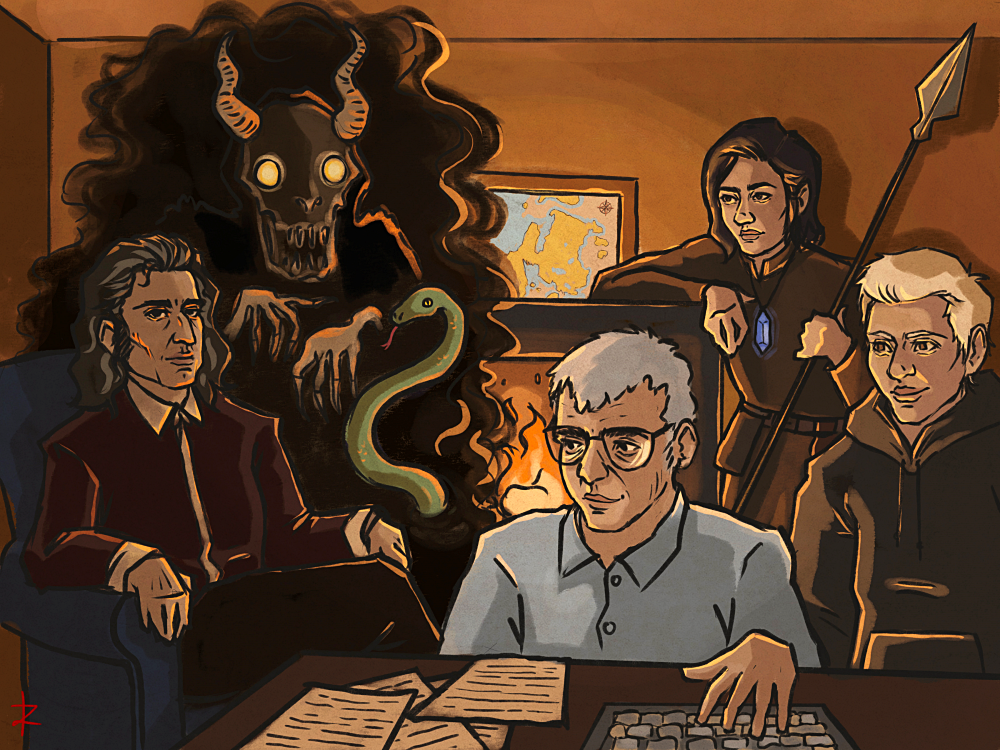
All books available in paperback from Afranor Books on Bookshop.org.
See below on the right-hand side of this page for links to other sellers.

Monday, April 24, 2023

Sunday, January 15, 2023
Same Books, New Portal
Something on this blog has changed.
At the top of this page, if you click on any of the three links for my own online bookstore Afranor Books, they will now take you to a different place than they did before.
It was only two years ago next month that I announced that I had become an online bookseller. As I acknowledged back then, calling myself a bookseller was something of an exaggeration. Ingram, the company that prints the paperback versions of my novels and distributes them to sellers, had encouraged its authors to set up their own online shops. For this purpose, they provided the portal (called Aerio), and we authors set up (within limits) the design and inventory. It was another way for readers of particular authors to find and buy their books.
Then a few days before Christmas, Aerio informed us that it was getting out of the authors-selling-books business. What? It seemed like I had only just set up my bookshop, and now I was being evicted?
The Aerio online storefronts will close down at the end of this month. If for some reason you need or want to visit my Aerio site before it vanishes, here (for the final time) is the link to it: shop.aer.io/AfranorBooks.
Aerio further suggested, if we wanted to continue to have a place (besides, of course, all the other online booksellers out there) to direct readers to purchase our books, that we consider Bookshop.org! Coincidentally, mentioned that site on this blog back in August when discussing issues with some of the more prominent online sellers.
As I wrote then, “They provide centralized ordering, delivery and customer service for a network of local independent bookstores. They are mostly in the US, but recently they have begun expanding internationally, specifically in the UK and Spain. Their website claims they’ve raised nearly $22 million for local bookstores.”
“This is how it works,” I continued. “On their website you select a local bookstore (there are more than 1,400 to choose from) you want to support. Once you’ve done that, any online orders you make from the website are fulfilled by Bookshop.org and the local bookstore gets 30 percent of the retail value.”
It turns out that Bookshop.org has an affiliate program for authors like me, so rather than giving up having my own online portal altogether, I have set up shop over there.
You can check it out by clicking this link: bookshop.org/shop/afranorbooks. Or any of the three other links (can find all of them?) at the top of this page.
Note: unlike the Aerio site, which sold both paperback and digital versions of my books, my Bookshop.org page just sells paperbacks. So, if you are looking for my novels as e‑books, you will want to select from among the many sellers of digital (and print) books listed along the right-hand side of this page.
At the top of this page, if you click on any of the three links for my own online bookstore Afranor Books, they will now take you to a different place than they did before.
It was only two years ago next month that I announced that I had become an online bookseller. As I acknowledged back then, calling myself a bookseller was something of an exaggeration. Ingram, the company that prints the paperback versions of my novels and distributes them to sellers, had encouraged its authors to set up their own online shops. For this purpose, they provided the portal (called Aerio), and we authors set up (within limits) the design and inventory. It was another way for readers of particular authors to find and buy their books.
Then a few days before Christmas, Aerio informed us that it was getting out of the authors-selling-books business. What? It seemed like I had only just set up my bookshop, and now I was being evicted?
The Aerio online storefronts will close down at the end of this month. If for some reason you need or want to visit my Aerio site before it vanishes, here (for the final time) is the link to it: shop.aer.io/AfranorBooks.
Aerio further suggested, if we wanted to continue to have a place (besides, of course, all the other online booksellers out there) to direct readers to purchase our books, that we consider Bookshop.org! Coincidentally, mentioned that site on this blog back in August when discussing issues with some of the more prominent online sellers.
As I wrote then, “They provide centralized ordering, delivery and customer service for a network of local independent bookstores. They are mostly in the US, but recently they have begun expanding internationally, specifically in the UK and Spain. Their website claims they’ve raised nearly $22 million for local bookstores.”
“This is how it works,” I continued. “On their website you select a local bookstore (there are more than 1,400 to choose from) you want to support. Once you’ve done that, any online orders you make from the website are fulfilled by Bookshop.org and the local bookstore gets 30 percent of the retail value.”
It turns out that Bookshop.org has an affiliate program for authors like me, so rather than giving up having my own online portal altogether, I have set up shop over there.
You can check it out by clicking this link: bookshop.org/shop/afranorbooks. Or any of the three other links (can find all of them?) at the top of this page.
Note: unlike the Aerio site, which sold both paperback and digital versions of my books, my Bookshop.org page just sells paperbacks. So, if you are looking for my novels as e‑books, you will want to select from among the many sellers of digital (and print) books listed along the right-hand side of this page.
Monday, December 19, 2022
Hand of Maradona
To my surprise Donal called out after him, “Just for the record, mate, you lot most definitely stole the World Cup.”That exchange from Chapter 14 of Searching for Cunégonde is about the first time Argentina won the World Cup in 1978. It is between Dallas Green’s English friend Donal and Alberto, one of a number of people the pair encounter in Dallas’s quest to find his long-lost friend Antonio. As they anticipate the next World Cup, Alberto tells Donal to watch out for an up-and-coming player named Maradona. Of course, Alberto has the full benefit of this author’s hindsight, but in fairness the young Maradona’s promise would have been apparent to most Argentine sports fans.
He stopped in his tracks and turned to face us.
“The cast on van de Kerkhof’s wrist was completely illegal,” he said with annoyance.
“Bollocks. You were stalling for time. You were doing anything you could to throw the Dutch off. You had your own referees, and they were so one-sided it was a bloody joke.”
“What the hell are you two talking about?” I asked.
“The 1978 World Cup. It was here in Argentina, and they bloody well stole it.”

For Argentina’s third World Cup trophy, it would have to wait until, well, yesterday. This time the World Cup was held (somewhat controversially) in Qatar, and it was Lionel Messi (born the year after Argentina’s previous most recent championship win) who led his country to victory in a knuckle-biting match with penalty shoot-out for the ages. I would like to think that, somewhere out there Alberto and Donal are still around and were watching like 14.9 million other viewers. Alberto would, of course, be crazy with joy over the triumph of his team, called la Albiceleste for its colors. Donal would be disappointed that England’s team (called the Three Lions for its insignia) crashed out at the quarter-final stage. Perhaps, though, he would take some consolation that his team did pick up the tournament’s Fair Play Award.
In other life-sort-of-almost-imitates-art news, Chile’s Láscar volcano rumbled back to life a bit more than a week ago. That wasn’t a complete surprise, as it is one of the most active volcanoes in the northern Chilean Andes. It is 38 miles from the Licanabur volcano, which isn’t believed to have been active for the past thousand years—and as far as I know still isn’t.
As readers of Last of the Tuath Dé will know, the interior of Licanabur is where the Grisial was created and is the the weakest point between our world and Tír nAill, otherwise know as the Otherworld and home of the Old Ones.
Speaking of Last of the Tuath Dé and Searching for Cunégonde, as well as my other novels, if you are stuck for gift ideas with only a few shopping days left until Christmas, books definitely make nifty presents.
Happy Holidays!
Tuesday, November 8, 2022
Colonel Mustard’s Return?
I have always loved the tone, quality and entertainment value of readers’ letters to The Times (“of London”). It was sort of a dream come true for me nearly a year ago when a letter of mine was actually printed in that newspaper—though it was “only” in the paper’s Irish edition. (In case you’re wondering, I was exhorting readers to sample as many diverse news sources as possible—even ones they might disagree with—in the interest of avoiding information blind spots.)
 I didn’t actually sit down and write the letter on a piece of paper and then drop it in a mailbox. It was originally a comment on an article on the Times web site, and an editor contacted me to verify my identity and to ask for permission to use it in the print edition. I don’t know if anybody actually writes letters to the editor on paper anymore. My guess is it’s all electronic now.
There was a good example yesterday of a classic Times reader’s letter or, rather, comment. It was beneath an article about new information on an old murder case suggesting the crime did not happen spontaneously but, in the words of an investigator, “it makes me think the whole thing was pre-planned.”
The most highly rated comment (with 114 recommendations as of this writing) on the article: “Isn’t planning pre-planning?” Say what you want about Times readers, but they care about the language.
You may wonder why am I am taking up space with all this on my book blog. It’s because the presumed murderer in the article was a certain Lord Lucan. He has been an object of fascination for the UK (and by extension the Irish) media since he vanished without a trace in 1974. This was immediately after his wife and his children’s nanny were attacked with a lead pipe. The wife survived, but the nanny, who was attacked first in a basement kitchen, died.
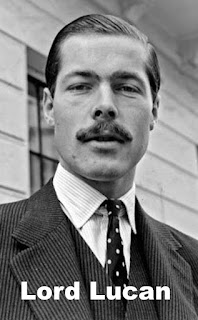 The newly revealed information is that three Cluedo game cards were subsequently found in a Ford Corsair that Lord Lucan had borrowed and which was found abandoned at Newhaven in East Sussex, suggesting he may have taken his life by leaping into the sea. The cards matched ones missing from a set owned by the lord. Which cards were they? Colonel Mustard, the lead pipe and the hall. Like Lord Lucan, the fictional Colonel Mustard is a former military man with a mustache. How very Agatha Christie.
The article further reveals that subsequently a woman insisted to police that she later met Lord Lucan at a party at a villa in the Algarve in Portugal. Today’s Irish Independent (like The Times, drawing from original reporting from The Daily Mail) informs us that a facial recognition expert, using AI photo analysis, has made what he claims is a 100-percent match between photographs of Lord Lucan and an 87-year-old pensioner in Australia. If they’re not the same man, says Professor Ugail, then they’re certainly identical twins.
On the other hand, my own neighbor here thinks I solved the mystery five years ago with the release of Lautaro’s Spear. His first comment after reading the book was that “you should have never killed off the other fella.” (He never forgave me for the demise of his favorite character from Maximilian and Carlotta Are Dead.) His second comment was, “We finally know what happened to Lord Lucan.”
The name of the infamous lord (born Richard John Bingham) never appears in Lautaro’s Spear, but in Chapter 3 Dallas Green and his friend Linda go to a restaurant called Balthazar’s in San Francisco where their waiter is a dapper Englishman named Richard. Later in Chapter 13 Dallas has a chat with Marty, the mysterious proprietor of a hole-in-the-wall Mexican restaurant in the Mission District. Dallas is taken aback when Marty brings up Balthazar’s.
Speaking holidays, it’s only 48 more shopping days until Christmas, so it behooves me to point out all the links on this page that will lead you to places to buy all kinds of great holiday gifts, including not only Lautaro’s Spear but also the other Dallas Green books as well as The Three Towers of Afranor, The Curse of Septimus Bridge and my newest tome, Last of the Tuath Dé.

There was a good example yesterday of a classic Times reader’s letter or, rather, comment. It was beneath an article about new information on an old murder case suggesting the crime did not happen spontaneously but, in the words of an investigator, “it makes me think the whole thing was pre-planned.”
The most highly rated comment (with 114 recommendations as of this writing) on the article: “Isn’t planning pre-planning?” Say what you want about Times readers, but they care about the language.
You may wonder why am I am taking up space with all this on my book blog. It’s because the presumed murderer in the article was a certain Lord Lucan. He has been an object of fascination for the UK (and by extension the Irish) media since he vanished without a trace in 1974. This was immediately after his wife and his children’s nanny were attacked with a lead pipe. The wife survived, but the nanny, who was attacked first in a basement kitchen, died.

The article further reveals that subsequently a woman insisted to police that she later met Lord Lucan at a party at a villa in the Algarve in Portugal. Today’s Irish Independent (like The Times, drawing from original reporting from The Daily Mail) informs us that a facial recognition expert, using AI photo analysis, has made what he claims is a 100-percent match between photographs of Lord Lucan and an 87-year-old pensioner in Australia. If they’re not the same man, says Professor Ugail, then they’re certainly identical twins.
On the other hand, my own neighbor here thinks I solved the mystery five years ago with the release of Lautaro’s Spear. His first comment after reading the book was that “you should have never killed off the other fella.” (He never forgave me for the demise of his favorite character from Maximilian and Carlotta Are Dead.) His second comment was, “We finally know what happened to Lord Lucan.”
The name of the infamous lord (born Richard John Bingham) never appears in Lautaro’s Spear, but in Chapter 3 Dallas Green and his friend Linda go to a restaurant called Balthazar’s in San Francisco where their waiter is a dapper Englishman named Richard. Later in Chapter 13 Dallas has a chat with Marty, the mysterious proprietor of a hole-in-the-wall Mexican restaurant in the Mission District. Dallas is taken aback when Marty brings up Balthazar’s.
“You would be surprised at the interesting stories lots of ordinary-seeming people have in their pasts. Here’s an interesting one. You ever been in a restaurant near Union Square called Balthazar’s?”My guess is that this exchange, which has absolutely no bearing on the rest of the book’s narrative (other than to establish Marty as a man with unusual connections and mysterious sources of information), went right over the heads of most readers. It would take someone, like my neighbor, who would be the right age and who lives on this side of the Atlantic to pick up on that reference. I believe this is what is known as an Easter egg.
“Yeah…” I said suspiciously.
This was a perfect example of the weirdness that went through my conversations with Marty. Balthazar’s was the only restaurant in that area I had ever been in. What were the odds of that?
“There’s a waiter there. His name is Richard. He’s an English guy.”
“Yeah, he waited on a friend and me.”
“You don’t say? Well, don’t tell anyone where you heard it, but that guy is a murderer.”
“You’re joking, right?”
“It’s true. I swear it.”
“If you know this for sure, shouldn’t you tell the police or somebody?”
“Nah, there’s no need for that. He only killed one time, and he won’t ever do it again. He was a British lord back in England—and a professional gambler—but things just didn’t go well for him. He was separated from his wife and children. One night he slipped back into the house and killed the nanny. Beat her to death with a lead pipe. Poor girl wasn’t even supposed to be working that night. Not sure if he mistook her for the wife or if she just got between him and the kids. Anyway, he took off and no one has heard of him since.”
Speaking holidays, it’s only 48 more shopping days until Christmas, so it behooves me to point out all the links on this page that will lead you to places to buy all kinds of great holiday gifts, including not only Lautaro’s Spear but also the other Dallas Green books as well as The Three Towers of Afranor, The Curse of Septimus Bridge and my newest tome, Last of the Tuath Dé.
Subscribe to:
Comments (Atom)